Showing posts with label retail technology. Show all posts

Thursday, November 19, 2015

57% of holiday shoppers have already begun


Photo from merchandisingmatters.com

By Laura Heller

Anyone looking for more proof that holiday shopping begins earlier has some new statistics to cite: 56.6 percent of those celebrating the holidays had begun shopping by early November, up from 54.4 percent last year and up further from the 49 percent who had started by this time in 2008, the first time the National Retail Federation asked the question.

It's the highest percentage seen in that timeframe, according to the NRF's Consumer Holiday Spending Survey conducted by Prosper Insights and Analytics. Some 21 percent of shoppers began before October, according to a recent Brand Keys survey.

"Thanksgiving weekend shopping has evolved tremendously over the past few years and can no longer be seen as the 'start' of the holiday season, though there's no question it's still important to millions of holiday shoppers and retailers of all shapes and sizes," said NRF President and CEO Matthew Shay. "There is a real sea change happening in retail when it comes to the how, when, where and why of holiday shopping. Consumers today are looking for great prices and value-add promotions earlier than ever before, and retailers have answered these demands in several different ways already this holiday season."


Younger shoppers are among the busiest early in the season. Nearly 65 percent of 25 to 34-year-olds and 62 percent of 35 to 44-year-olds say they have already started shopping.

 "While there are many 'Type A' holiday shoppers who love to get an early start on their wish lists, it's also likely some of the early shopping we've seen has been in the form of 'self-gifting,' and there's no question millennials love treating themselves to something when the price is right," said Pam Goodfellow, principal analyst and consumer insights director for Prosper. "And with Thanksgiving, Black Friday and Cyber Monday still to come, holiday shoppers of all ages are still in for a treat when it comes to unbeatable promotions."


 Hot gift items this year include apparel and accessories (60 percent); books, CD's and DVDs (46 percent); and toys (41 percent). One in five will buy jewelry, and 30.5 percent will spend on food or candy.


 And for the first time, the number of shoppers who intend to buy gift cards has declined: 56.3 percent plan to buy cards, down from 60 percent last year, despite gift cards being the most requested gift item, according to NRF.


 Thus far in the season, retailers are getting high marks from shoppers when it comes to promotions. Slightly more than 40 percent rank retail promotions as excellent or good, and another 34.8 percent said they were average.


 Retailers' attempts to reach millennials with more targeted messaging and promotions appear to be working as well. Nearly 59 percent of 18 to 24-year-olds and 54.5 percent of 25 to 34-year-olds agree retailers' deals have either been excellent or good.
To View Original Article: http://www.fierceretail.com/story/57-holiday-shoppers-have-already-begun/2015-11-13

Monday, August 10, 2015

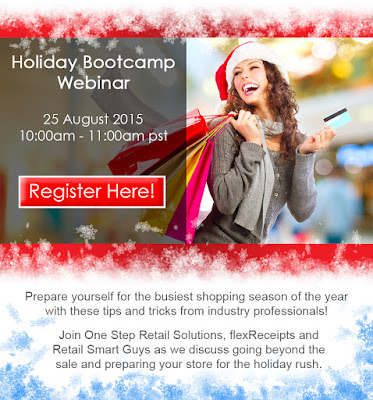
Holiday Bootcamp Webinar on 8.25.15

https://attendee.gotowebinar.com/register/8025628208609442561
 

Join us for our annual Holiday Boot Camp webinar to help prepare yourself for the busiest shopping season of the year with these tips and tricks from industry professionals!

Friday, July 24, 2015

Where will payment hackers go post-EMV?

By | July 23, 2015                                                             

Right now, in the midst of summertime—school vacation, camping trips, beach days—it’s hard for anyone to imagine Oct. 1. But it’s top of mind for retailers, which will experience a shift in liability, from credit card companies and banks to themselves, whenever a credit card is compromised by fraud if they haven't updated their systems to be EMV-compliant.
 
All retailers should have their EMV (which stands for Europay, MasterCard, Visa) point-of-sales systems ready to go on Oct. 1 to handle the new credit cards that are far more difficult to hack. 
Until then, U.S. consumers are blithely swiping their credit cards and debit cards with magnetic strips holding access to their money, their good credit, and even their personal information. These simple magnetic strips have been compared to an eight-track cassette and are fairly porous to data-sucking thieves.
 
New EMV cards will have a shiny metallic square containing a more secure chip and most can also use Near-Field Communications to make a payment. The new POS systems are expected to be much safer than their predecessors, helping retailers prevent the kind of massive fraud that have infamously compromised the payment systems at Home Depot, Target, Neiman Marcus, Michaels, and others.
 
But hackers aren’t just going to disappear after this switch to EMV cards and POS systems that accept them. And it’s safe to guess that they’ll likely go online.


Retailers are unprepared for online fraud

While omnichannel retailers may be preoccupied with preparing for Oct. 1, they may not be prepared for what experts say is the inevitable shift to online payment fraud. The good news is that, if a retailer is hit, it can be a sign of business success.
 
“If someone hits you, it’s a bittersweet moment, that you’re big enough that someone wants to take advantage of you and your many transactions,” Jason Tan, CEO and founder of fraud detection company Sift Science, told Retail Dive. “The trouble is, as long as you keep growing and your business is thriving you’re always going to see fraud.”
 
The reality is that online fraud will jump, and retailers by and large aren’t ready for that. That could mean a new season of breach stories and a different kind of nightmare. 
 
“Offline merchants are generally prepared because it’s mandated by the credit card companies and they have a big liability shift coming,” Tan says. “I don’t think the online merchant is that prepared because human nature is to procrastinate. In other countries the year after the EMV mandate, online merchants saw two times the fraud. That’s a massive massive jump in fraud — so how do you how install a defense mechanism so that doesn't keep you up at night?”


The good news: The technology is here

While EMV technology has been employed for a while abroad, it’s just now arriving in the states. But the technology to tackle and prevent online fraud is here now. Tan notes that Sift Science tackles fraud issues using machine learning behavior technology with APIs and advanced modeling to track, score, and categorize online transactions. 
 
Using such algorithm-based systems, Tan says, is far superior to the human-led, human-dependent rules-based systems that most retailers use now.
 
“There are too many orders from manual review that require a full time staff, and, worse, they’re not accurate,” he says. “You want to be able to stop the bad users, but let in the good customers easily.”


Convenience remains important 

That's it, of course: the key is to find effective technology keeps data safe without overly inconveniencing shoppers. Making checkout too difficult is a recipe for cart abandonment. 
 
It’s a disaster when hackers find their way onto a retailer’s site, but it can be deadly to a sale if authentic customers there to buy have to deal with awkward, time-consuming fraud prevention measures. Tan says that Amazon is an example of a company that uses technology extremely effectively, and knows how to keep the checkout system humming smoothing for its fraud-free customers.


The bad news: Trouble's still lurking

It’s easily forgotten that a major pipeline to online fraud is the telephone. Unscrupulous retail or hotel employees often obtain credit card numbers over the phone during a sale or customer service transaction and sell them for use online, Laurence Cooke, founder and CEO of loyalty and payment platform nanoPay, told Retail Dive.
 
“It’s so much easier to steal a card when you’re being read the card numbers on the phone,” Cooke says. “What doesn’t go away with EMV is that cards are captured on phone orders or catalog orders, and then they get used online.”
 
EMV transactions will be palpably slower than credit card swipes are now, which might prompt people to use contactless payments.  
 
“When you use a mobile app,” Cooke says, “it’s a more secure way, but as easy as swiping or tapping.”
 
That means that the switch to EMV, and the resulting added risk of online fraud, have a good chance of boosting the adoption of mobile payments, Cooke believes.
 
And if retailers are smart enough to take advantage of mobile’s data collection capabilities and streamline their online systems in ways like those Tan describes, they will also be able to develop more effective loyalty programs. That in turn could move mobile payment adoption even more swiftly.
 
Indeed, while Tan gives Amazon credit for its ability to quickly nab dubious payments, Cooke similarly gives the e-retail giant props for its loyalty program. The two things turn out to be tightly connected.
 
“The reason Amazon beats Wal-mart isn’t because they have better supply chain or better options,” Cooke says. “It’s that Amazon knows everything about you and Wal-Mart knows nothing about you. Wal-Mart may have discounts, but they may not be relevant to you at all.”
 
If retailers want to, they could leverage mobile to help make payments more secure and, in turn, help them get to know their customers in the same way.


NFC, Apple Pay, Androiddoesn’t matter

Cooke is fairly agnostic about whether the road to greater mobile payment adoption is Near-Field Communication, Apple Pay, or Google Wallet. 
 
“I don’t think Apple Pay can be completely successful everywhere without Android also being completely successful,” he says. “My only opinion is that it should be up to retailers to choose. We shouldn’t try to force it.”


The bottom line

Above all, retailers need to realize that there’s no magic fraud protection in EMV, or in mobile payments, or machine learning for that matter.
 
"I don’t think it’s black and white— I don’t think you’re either secure or not," Tan says, "The hackers and the fraudsters are always working.”


Friday, June 19, 2015

One Step Retail Solutions Introduces our Health Monitor

.

One Step Retail Solutions introduces their new managed service, Health Monitor. In this brief 3 minute video, we discuss the benefits of our Health Monitor, why it's important to implement and how to get started.

To view the original page please visit: https://vimeo.com/131148539

Friday, June 12, 2015

Keeping Up With the Shifting Retail Scene

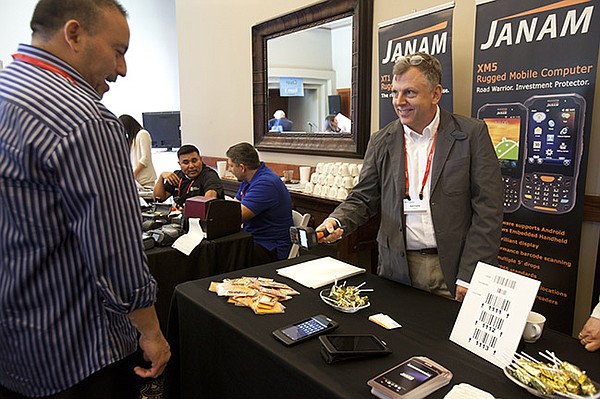
SCAN MAN: Janam showing an attendee how their scanners work and what their booth is all about.
SCAN MAN: Janam showing an attendee how their scanners work and what their booth is all about.    
By Deborah Belgum | Thursday, June 11, 2015          

Retail is an ever-changing landscape that is expanding to different horizons all the time. Many retailers are so baffled about how to be up-to-date and incorporate the maze of software out there that they don’t know where to start.

But experts have one major piece of advice: Do nothing and you die.

Whether you should be sending out emails, setting up in-store events, developing a loyalty program or posting to Facebook, something has to be done. “The first thing I want to set in your mind is if you are unable to recognize and engage your customer across every channel, your competitor will,” said Mike Mauerer, chief executive of Teamwork Retail.

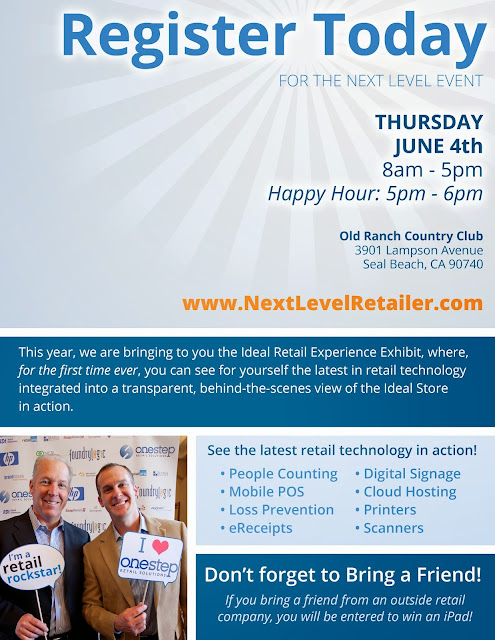
Mauerer was speaking at a one-day seminar organized on June 4 by One Step Retail Solutions, a Glendale, Calif., company that improves retailers’ operating efficiencies through technology. The seminar, called “Taking It to the Next Level,” was held at the Old Ranch Country Club in Seal Beach, Calif.

Most retailers, Mauerer said, are attempting to build extensive customer email lists; posting information on various websites and channels such as Facebook, Twitter, Pinterest and Instagram; and monitoring their online shopping. “They are spending money like crazy on different things, and their staff is overworked trying to keep up with orders and synchronizing various sites,” he said.

While many retailers think that this is embracing the omnichannel way of doing business, they’re wrong. This is called multichannel.

To be truly omnichannel, the various systems have to work on one platform and talk to each other instead of acting as silos of information. That means that if a customer purchases an item with your mobile-phone app, they should be able to come into your store and return it without a hassle. The store employee should be able to call up the receipt at the cash register and see where the item was purchased and make the return easily, delivering something called “frictionless retail.”

“Most retailers are multichannel today,” Mauerer said. They need to be omnichannel, particularly when it comes to embracing shopping on smartphones and melding that system into the rest of the system. “Your customers spend more time on their phones than they ever will in your store,” he noted.


Capturing consumer information

Customers are a retailer’s most important asset. Communicating with them is paramount for conveying messages about promotions, new merchandise and special events.

“The thing that drives traffic more than anything else is email marketing,” said Dan Jablons, owner of Retail Smart Guys, a retail consulting company based in the Los Angeles area. “For every dollar you spend on emails, you get $4 back.”

But developing a good email list can be challenging. “You have to add it at the point of sale,” Jablons advised. “But don’t ask them, ‘Would you like to be on our mailing list?’ That is like saying, ‘I have some extra garbage. Would you like me to drop it on your front lawn?’ You have to make it worth something. Stop calling it an email list and start calling it a VIP list.”

“If they think there is a VIP discount or they will be invited to a special event from being on the VIP list, they will give you their dental records,” Jablons added.

That email list can be used to rustle up customers on a deadly slow Monday. “If you are freaking out about no traffic and you have to pay the rent, send out an email about a discount on sweaters and 15 people will show up,” the retail expert said.

Another successful marketing tool is holding in-store events where proceeds benefit a local charity or organization. Being tied to the community and helping out wins over customers who will patronize your store because it is a part of the neighborhood. Attracting shoppers to an event can involve discounting items, having entertainment or serving food. “As a friend says, ‘If you serve booze and chocolate, everyone will show up,’” Jablons noted.


Developing loyalty

The National Retail Federation recently conducted a study and found that the average American consumer belongs to 23 loyalty programs—from hotels and airlines to grocery stores and drugstores. “Customers want them,” said Ron Friedman, head of Friedman Business Consulting.

He noted that the first loyalty program was developed in 1896 by S&H Green Stamps, with stamps given away with purchases and pasted into books later redeemed for products.

There are various kinds of loyalty or reward programs. Friedman believes that cash back after a purchase is the wrong way to go. “Wouldn’t it be better to tell them about the $5 off before they come into the store?” he asked.

Friedman’s favorite loyalty program is the gift card that can be used by anyone and shouldn’t expire. Transferrable gift cards serve as a referral program to friends and relatives. Customers frequent you more often with a gift card in hand and spend more.

Target is an example of a retailer that gives away a gift card if a certain item is purchased. “When Target advertises this, the item is not on sale. So they get full price on the item, and you have to come back to the store to shop again,” Friedman said.


Hiring and firing

Developing a good sales staff is essential to keeping customers coming through the doors. But how do you do that?

Jablons of Retail Smart Guys suggests auditioning potential salespeople. “Try a sample shift from 1 to 3 p.m. on a Saturday. Tell them you will pay them, and then see if they can start a conversation with a customer who comes into the store and then have them pass the customer on to the sales staff,” he said. “You want to find out if they can start a conversation with a customer rather than having them walk around the store like Frankenstein.”

Jablons also recommends writing a job description and using that job description as a template for training new employees. “Once you have hired them, the biggest mistake I see is that there is not enough time spent on training,” he said.

If you have salespeople who are extremely funny, put them toward the front of the door. Also, train them to be knowledgeable about the products they are selling. “Every vendor has a story to tell, such as these sweaters were knit by monks in the Himalayas. So then your salesperson can tell the customer, ‘These sweaters were knit by monks in the Himalayas.’”

And if you find out your new salesperson can’t operate a cash register or point-of-sale system, don’t keep them. “If you don’t, your next career will be unraveling the crazy things they did at the register,” Jablons explained. “This is the spinal cord of your business.”

To view the original article please visit: https://www.apparelnews.net/news/2015/jun/11/keeping-shifting-retail-scene/

Wednesday, May 20, 2015

Are You Providing a Hyper-Relevant Experience for Shoppers?

 
Personalization is a hot topic in retail today, and retailers are paying close attention, rolling out beacon technology to track shoppers’ actions, focusing marketing materials to capture their attention and encouraging customer service training. But a recent study from Cisco Consulting Services finds that  today’s consumers are really seeking a hyper-relevant experience even more than a hyper-personalized one.

Technology has allowed consumers to reach out to brands at any time and from any place, and this has resulted in customers looking for more personalized interactions from retailers, as people want their patronage to be valued and appreciated.

That means that shoppers want to find what they came for and pay in a streamlined fashion. Some might want to be addressed by name, but it seems that’s not a deal breaker. What is important is getting the basics right consistently. For example, the Cisco study found 39 percent of respondents said that greater efficiency in the shopping process (e.g., ensuring items are in stock, speeding checkout times) as the top area retailers need to improve. Compare that with the 13 percent who said a more personalized shopping experience was the #1 concern.

Concentrating on efficiency has two benefits. One, retailers cut costs be eliminating waste and superfluous practices. And customers get the benefit of quicker, more responsive service. Customers end up happier, and, as a result, more loyal to those stores that make shopping easier. Retailers that build agile business processes to turn these insights into value can capture a profit improvement of 15.6 percent, according to Cisco Consulting Services.

Combining mobile technology with the in-store experience is no longer just for early adopters — it is mainstream. The next step is integrating mobile with the technology powering the Internet of things. IoT lets shoppers connect to retail in ways that makes their shopping experiences more enjoyable, and helps retailers create relevant customer experiences.

Shoppers typically want to engage a technology solution if there is a benefit for them attached. Those benefits might be in terms of cost, efficiency or engagement. To meet those needs, for example, a retailer might:
  • use digital signage to inform shoppers of a “flash” sale. The “smart sign” is notified by an IoT powered backend system about a stock situation. Preprogrammed parameters cause the promotion to launch, helping retailers clear out inventory, and can guide customers directly to the merchandise;
  • implement a buy-online-pickup-in-store solution that provides current inventory information to shoppers beginning their journey online, but opting to finish it in store;
  • provide interactive mirrors for trying on clothes, capturing the image and sharing on social media.
By investing in Internet of Things technologies, some retailers are attempting to engage consumers, attract them to stores, and attempt to cross-sell and up-sell. It’s yet another tool in a box that can never be too full.


To see the original article please visit: http://www.retailpro.com/News/blog/index.php/2015/05/11/are-you-providing-a-hyper-relevant-experience-for-shoppers/

Interested in hearing more about Retail Pro or want to talk to them in person? Join us for Take it to the Next Level: The Ideal Retail Experience on June 4th at Old Ranch Country Club in Seal Beach!! Register today at https://nextlevelretailer.com
 

Friday, February 27, 2015

Key trends for retail technology in 2015: the rise of hyper-personalisation

Trends in customer experience management

By World of tech 
 
Keyboard
 
This year, customer experience management will be mostly focused on customer personas, rather than portfolios. It is increasingly critical for retailers to innovate in terms of customer experience to keep shoppers engaged.
 
Only by serving the changing needs, preferences and behavior of the customer, will retailers and brands be able to meet today's hyper-connected consumers on their terms, across all channels of interaction.
 

The rise of hyper-personalization

 
Over the course of last year, we saw a spike in customer expectations for bespoke personalisation across all brand interactions. Sephora's Beauty Insider loyalty programme allows shoppers to save "loves" and purchases (both online and in-store) in a Beauty Bag, and also leverages a shopper's profile to link specific customer attributes (such as skin tone) with products for sale within the store. Information is accessible across devices – even on iPads at store counters. By providing relevant, accurate services in exchange for customer data, Sephora is paving the way in persona-driven customer innovations.
 
Real-time interaction with customers across omni-channel platforms signified another key milestone last year. Retailers can use information from online buying behaviour to serve customers at the point of sale based on the relevant input he or she needs. This closes the gap between online and physical shopping experiences that previously created headaches for a lot of retail brands.
Customers want this, too, because they can get better offers and more tailored recommendations to what they want, when they want it. We currently partner with retailers to deliver what we call "Relevance in Store." By combining customer data gathered online and in-store, retailers can deliver a customer experience centred on value and convenience in exchange for customer information, and enabled by new apps and mobile technologies such as iBeacon.

How personalisation is influencing brands and retailers


The concept of data science as a skillset within a retail environment has become more significant. Data scientists understand customer data and can leverage open source technologies to rapidly develop scalable ways to synchronise in-store data with online intelligence for better services and recommendations. This can be very disruptive at first, but if it's executed well, it is a very rewarding experience that can generate a lot more value for the business, and for the customer too.

Gartner has predicted that by 2017, 89% of marketing leaders expect customer experience to be their primary basis for competitive differentiation. To align the organisation's investment in people, processes and technologies for this initiative, Gartner further recommends that businesses should hire a chief customer officer if they haven't done so already.

In spite of intentions to create consistent cross-channel experiences, today's shopper experience is a highly disjointed one, driven largely by the fact that retailers rely on legacy systems, disparate databases and applications that cannot speak to one another. As a cross-functional leader, the chief customer officer can help unify these disparate experiences and drive a truly seamless experience that bridges all customer touch points.

Data science will add the extra layer of customer intelligence to help retailers deliver more personalised, more relevant, and more meaningful campaigns that suit individual shoppers' needs.

Mobile and iBeacon technologies will be another key trend that will shake up the customer experience management in 2015. Some retailers have already started experimenting with some degree of success.

As consumers upgrade their smartphones with new apps and location-based functionalities, retailers will have more accurate, geo-based data to pinpoint specific promotional offers and concierge services for shoppers as they walk across the shop floor.

To view the original article please visit: http://www.techradar.com/us/news/world-of-tech/key-trends-for-retail-technology-in-2015-the-rise-of-hyper-personalisation-1281156

Monday, February 16, 2015

A Look At The Retail Model Of The Future

By: Barbara Thau

Changing consumer shopping tastes and expectations are quietly transforming the retail industry.

Shoppers  increasingly crave instant gratification, one-of-a-kind merchandise and are cozying up to the idea of borrowing goods versus buying them.

As a result, the shopping model of the near future is poised to look radically different from just a decade ago, and retailers that don’t keep pace with changing tastes are setting themselves up for a rude awakening, at best, or extinction, according to Bashar Nejdawi, president of Ingram Micro Mobility, North America, a provider of technology and supply chain services.
For one, “In five years, consumer electronics stores as we know them today won’t even exist, and the same rings true for our favorite apparel brands,” he told Forbes.

“Technological innovations and a hyper-connected world have significantly influenced consumer behaviors and expectations. As a result, retailers are faced with a scary reality: change or become obsolete.”

Nejdawi detailed what he pinpoints as the three seminal consumer expectations fueling this shift in the retail landscape: instant gratification, borrowing and customization.

Instant Gratification
“Companies like Uber, Grub Hub, and Amazon have forever changed the way consumers think about service and how they go about their daily lives. They are no longer willing to wait for a taxi on the corner without knowing when it will arrive or trust the restaurant that promises delivery within 45 minutes. Instead, consumers want as much information at their fingertips as possible and as soon as possible.

“It’s becoming increasingly more common for retailers to rely on their supply chain partners to become the system of record for their inventory. Retailers will send their data to the third party logistics provider or link their POS [point-of-sale] system with them in order to provide an up-to-date, holistic view of what’s immediately available on store shelves, thus satisfying the consumer’s need for immediate access to information. As such, retailers must be able to deliver an intuitive experience in stores and online or they will lose customers’ loyalty.”

Borrowing
“What happened to the Boomers’ American dream of owning their first car or home? Today, we ‘Rent the Runway,’ ‘Zip car’ ourselves to and from the grocery store, and ‘Netflix NFLX +2.12%’ our shows. We want to own very little in order to consume more. Take the car for example: according to the AAA Foundation for Traffic Safety, cars purchased by 18 to 34 year olds fell almost 30% between 2007 and 2011.

“In the electronics space, we are seeing mobile device rental programs skyrocketing. Consumers ask themselves why they should pay $600 for the latest device when it’s going to become outdated within 12 to 18 months. Instead, they are opting to lease it for a minimal cost in order to get the next hottest gadget faster.

The borrowing culture begs the question: ‘How can retailers possibly handle the constant influx of product and get it in and out of consumers’ hands quickly enough?’”

Customization
 “In addition to wanting to know as much about products and services as possible and having the ability to quickly exchange an older model, consumers also want to ensure products are tailored to their individual lifestyles and preferences. For example, miAdidas allows consumers the ability to create their own shoes online with personal designs, pictures or logos. Retailers of the future will need to ensure that their supply chains are also evolved enough to handle the demand for custom orders.”

What Will The New Retail Model Look Like? Selling ‘Experiences’ Over Products
“Apparel retailers are light years ahead of the curve when it comes to who is more successfully building a new retail model that addresses these new consumer demands. But there is massive potential for consumer electronics retailers and other verticals to step up and meet the challenge. Imagine walking into your local Best Buy BBY -0.2% and seeing winter jackets on the show floor. In today’s retail climate this might look out of place, but the electronics retail store of the future will also sell smart apparel — picture a winter coat with a built-in smart watch.

“Additionally, stores of the future will emphasize selling experiences and lifestyles over products. Think about how revolutionary it was when Fleet Feet Sports allowed consumers to run down the street in a pair of shoes to experience the fit and feel. Now apply that idea and kick it up a notch: picture visiting a consumer electronics store to solve your health and fitness needs. Sales representatives can outfit you with a fitness tracker that reads your oxygen levels and heart rate to test your performance and wellness on an in-store obstacle course. Although consumers are testing out the product, they are also getting a glimpse into what their experience would be with that product in their day-to-day lives.

“Another great example of the retail model of the future is to provide value-added services attached to a product. For example, if a consumer is buying a new phone then the retailer should automatically offer in-store classes to train the consumer on the device.”


To see the original article please visit: http://www.forbes.com/sites/barbarathau/2015/02/10/a-look-at-the-retail-model-of-the-future/

Retail Twitter Handles to Follow


General Retailing, Industry News and Tips
Retail Week
@RetailWeek
Retail Wire @RetailWire
RIS @RISnewsInsights
Hanover Research @hanover4bix
Retail Minded @RetailMinded
Retail Online Magazine @RetailOnlineMag
One Step Retail Solutions @OneStepRetail
Future of Retail Alliance @joinFORA
NY Times Retail Reporter
@stephcliff

Retail Technology / Technology
Point of Sale News @PointOfSaleNews
One Step Retail Solutions @OneStepRetail
Tech Crunch @TechCrunch
Retail Digital
@RetailDigital
NCR Counterpoint: @NCRCorporation
Retail Pro: @RetailProNews

Hiring / Personnel
The Retail Life @theRetailLife
Find Hire @FindHire
Work in Retail @WorkinRetail
NRF Retail Careers @Retail_Careers

Consultants / Training
Evan Carmichael @EvanCarmichael
Retail Smart Guys @danjab
Retail Touch Points @RTouchPoints
Retail Concepts @RetailConcepts
The Retail Doctor @theRetailDoctor
Retail Mavens
@RetailMavens

Associations
NRF News - National Retail Federation @NRFnews
RSPA @RSPA
Board Retail Association @BoardRetailers
Florida Retail Association @FloridaRetail
Michigan Retail Association @MichRetail
California Fashion Association: @calfashion
Canadian Apparel Federation: @caf_apparel
Museum Store Association: @MSAconnect
Jewelers of America: @Jewelers_JA
Association of Zoos and Aquariums: @zoos_aquariums
American Nursery & Landscape Association: @american_hort
American Apparel and Footwear Association: @apparelfootwear
Brewer’s Association: @BrewersAssoc
Footwear Distributors and Retailers of America: @FDRA
Game Manufacturers Association: @GamaOnline
International Council for Shopping Centers: @ICSC
National Association of Sporting Goods Wholesalers: @NASGW_Pros
National Sporting Goods Association: @NSGASportingGds
North American Home Furnishings: @theNAHFA
Sports and Fitness Industry Association: @theSFIA

Visual Merchandising and Design
Retail Details @retail_details
King Retail Solutions @KingRetail
DDI Online @DDItweets
Store Signs @StoreSigns
Retail Design Blog: @RetailDesignBG

Promotion and Marketing
Snap Retail @SnapRetail
Brand Spank @BrandSpankShop
Plastic Resource @PlasticResource
Postcard Mania @PostcardMania

Retail Real Estate
Retail Traffic @RetailTraffic
CBRE @CBRE

Style and Fashion
Racked National @Racked
Lifestyle Lemonaid @LifeStyleLemonaid
Women's Wear Daily @WomensWearDaily
Refinery29 @refinery29
Red Carpet Fashion: @Fashion_Critic_

Wednesday, February 11, 2015

13 Retail Blogs You Should Follow


Description: “At SnapRetail, we want to make life easy for local retailers…We want them to have more - more time, more traffic and more sales. That's why we've developed a system that helps them easily engage and sell to customers using email and social media.”
Follow them at: @SnapRetail
Article we recommend: Marketing to Millennials


Description: “We are a user experience agency for brick & mortar retailers.”
Follow them at: @BRANDSPANKshop
Article we recommend: Customer Service is Branding
 
 
Description:Unlock the power of a digital receipt that builds your brand,
engages your customers and transforms your business with
valuable analytic insights.”
Follow them at: @flexReceipts
 
 
Description: Our professionally certified business partners provide local training, service, support, and regulatory compliance so you can grow your business no matter where it takes you.
Follow them at: @RetailProNews
 
 
Description: “NCR Counterpoint includes robust point-of-sale, inventory management software, built-in customer loyalty, automated purchasing, and configurable reporting capabilities.”
Follow them at: @NCRCorporation


Description:Retail TouchPoints (RTP) is an online publishing network for retail executives, offering content focused on optimizing the customer experience across all channels.”
Follow them at: @rtouchpoints


Retail Minded
Description: “Retail Minded is a trusted resource for independent retailers and other small business owners.”
Follow them at: @retailminded
 
 
Description:Smart Retailer covers all of today’s popular styles, including country, traditional, vintage, coastal and more, and it provides new-product previews, trend reports, display ideas, and valuable business advice to help retailers build smart businesses.”
Follow them at: @Smart_Retailer
 
 
Description: “…merchants use our platform to manage every aspect of their business — from products to orders to customers, selling online, in retail stores, and on the go.”
Follow them at: @shopify
 
 
Description: “I work with retailers just like you who are good at what they do; however, they have never been taught exactly how to run their stores more profitably or more effectively.”
Follow them at: @retailmavens
 
 
Description: Their complementary skill sets and diverse backgrounds give their company and retail trainers at WhizBang! Training a one-two punch of street-smart independent retail store owner and highly trained retail pro.”
Follow them at: @BobNegen
Article we recommend: 7 Marketing Mistakes


Retail Digest Brought to you by Vend
Description:Welcome to The Retail Digest – the world’s best site for retail news and information, curated by the top 100 industry thinkers and doers, and upvoted by people like you.”
Follow them at: @theretaildigest
 
 
Description:Our mission is to advance the interests of the retail industry through advocacy, communications and education.”
Follow them at: @NRFnews