Showing posts with label shopping. Show all posts

Thursday, November 19, 2015

57% of holiday shoppers have already begun


Photo from merchandisingmatters.com

By Laura Heller

Anyone looking for more proof that holiday shopping begins earlier has some new statistics to cite: 56.6 percent of those celebrating the holidays had begun shopping by early November, up from 54.4 percent last year and up further from the 49 percent who had started by this time in 2008, the first time the National Retail Federation asked the question.

It's the highest percentage seen in that timeframe, according to the NRF's Consumer Holiday Spending Survey conducted by Prosper Insights and Analytics. Some 21 percent of shoppers began before October, according to a recent Brand Keys survey.

"Thanksgiving weekend shopping has evolved tremendously over the past few years and can no longer be seen as the 'start' of the holiday season, though there's no question it's still important to millions of holiday shoppers and retailers of all shapes and sizes," said NRF President and CEO Matthew Shay. "There is a real sea change happening in retail when it comes to the how, when, where and why of holiday shopping. Consumers today are looking for great prices and value-add promotions earlier than ever before, and retailers have answered these demands in several different ways already this holiday season."


Younger shoppers are among the busiest early in the season. Nearly 65 percent of 25 to 34-year-olds and 62 percent of 35 to 44-year-olds say they have already started shopping.

 "While there are many 'Type A' holiday shoppers who love to get an early start on their wish lists, it's also likely some of the early shopping we've seen has been in the form of 'self-gifting,' and there's no question millennials love treating themselves to something when the price is right," said Pam Goodfellow, principal analyst and consumer insights director for Prosper. "And with Thanksgiving, Black Friday and Cyber Monday still to come, holiday shoppers of all ages are still in for a treat when it comes to unbeatable promotions."


 Hot gift items this year include apparel and accessories (60 percent); books, CD's and DVDs (46 percent); and toys (41 percent). One in five will buy jewelry, and 30.5 percent will spend on food or candy.


 And for the first time, the number of shoppers who intend to buy gift cards has declined: 56.3 percent plan to buy cards, down from 60 percent last year, despite gift cards being the most requested gift item, according to NRF.


 Thus far in the season, retailers are getting high marks from shoppers when it comes to promotions. Slightly more than 40 percent rank retail promotions as excellent or good, and another 34.8 percent said they were average.


 Retailers' attempts to reach millennials with more targeted messaging and promotions appear to be working as well. Nearly 59 percent of 18 to 24-year-olds and 54.5 percent of 25 to 34-year-olds agree retailers' deals have either been excellent or good.
To View Original Article: http://www.fierceretail.com/story/57-holiday-shoppers-have-already-begun/2015-11-13

Friday, July 31, 2015

Omni- Channel Shoppers: An Emerging Retail Reality

Written by Julie Krueger, March 2015 
Retail marketing is changing. Today, success means connecting with your most important customer: the omni-channel shopper. Here we detail the three ways retailers can reach this shopper by measuring behavior, providing localized information, and creating the right organizational structure.

The way we think about and approach retail marketing is changing. Today, success means reaching consumers wherever they are, on whatever device they may be using. Increasingly, that means smartphones. According to Google data, for much of the 2014 holiday season, mobile shopping clicks exceeded those on the desktop as shoppers made their purchase decisions on the go. And people are no longer discriminating between mobile and desktop when it comes to shopping—whether that's in a store or on an e-commerce site. This is creating new realities for retailers, as we've seen from our recent research with Ipsos MediaCT and Sterling Brands. Chief among them is the fact that digital doesn't just drive e-commerce; it gets people in the store. And this influence doesn't end at the entrance to the store: 71% of shoppers who use smartphones for research in-store say that it's become an important part of the experience. Smartphones are the new personal shopping assistant for people once they're inside.              
As digital continues to touch every step of the customer journey, multi-channel retailers who operate both e-commerce and in-store channels are having to take note. They're changing the way they think about omni-channel shoppers (for instance, Banana Republic customers who shop both online and in-store) and what their shopping behavior means for the overall business. The most sophisticated retailers are ensuring their marketing strategies are geared toward enabling customers to convert on any channel. Why? Because they realize that a shopper who buys from them in-store and online is their most valuable kind of customer. According to a 2015 study by IDC, these shoppers have a 30% higher lifetime value than those who shop using only one channel.
 
Retailers can reap the revenue benefits of omni-channel shopping, but only if they know how to attract and connect with these highly desirable consumers. Doing so requires a deep knowledge of how these shoppers behave. It also requires structuring the company to be able to act on these insights. Let's be honest: This is much easier said than done.
             
Using examples from retailers who have started to make this shift, we detail the three keys to connecting with omni-channel shopping: measure behavior, provide relevant and local retail information, and create an organizational structure that supports omni-channel marketing.

Measure cross-device and online-to-store shopping behavior

To engage omni-channel shoppers, you first need to understand who they are. At a basic level, this means knowing important factors about the customer such as gender, demographic, location, website browsing habits, search habits, and where they shop in-store. But that's not enough.

Top retailers understand their customer in even greater detail. They measure the influence of all touchpoints on a customer's journey to purchase—online, offline, and across devices—using sophisticated measurement systems. These attribution platforms track the customer's journey through each channel—TV, display, search, email, and direct mail—providing a holistic view of how a valuable customer makes a purchase.
             
Using sophisticated measurement, leading retailers can answer important questions about their ideal customer. For example, does she shop across a mix of online and offline channels before making a purchase? Is she likely to visit a retailer's mobile site? Has her purchase frequency increased as a result of a specific marketing campaign? Is mobile assisting her in-store purchase? What marketing channel or ad type would be most helpful in drawing her into a nearby store? Where can a retailer find more customers like her?
             
Armed with better measurement insights, retailers can, for example, better use online channels to draw shoppers into their stores. "One in four who click on mobile search ads end up in a store, so we've realized that the in-store experience needs to continue to build on that bridge we've made in digital," says Evan Conway, Sprint's vice president of digital. And Sprint was able to understand the full, cross-channel value of its search advertising as well: Sprint's own data shows that for every sale that paid search ads generate online, paid search ads drive five in-store sales.
             
Sears Hometown and Outlet Stores and PetSmart, for example, are using Google AdWords' Store Visits to see whether their ads are driving in-store visits and purchases. By measuring valuable actions beyond clicks—phone calls, cross-device conversions, and even store visits—retailers can see how their digital efforts are affecting in-store sales. "We've always known that our digital efforts had an impact on store traffic, but it was difficult to quantify. These tools have helped us both with our ad formats and in our evaluation of their impact," says David Buckley, chief marketing officer of Sears Hometown and Outlet Stores. PetSmart, too, found that search ads had a direct impact on store visits. According to Google's Store Visits metric in AdWords, 10–18% of all clicks on its search ads resulted in an in-store visit within 30 days.
             

Provide omni-channel shoppers with relevant, local information

Once you begin to understand the relationship between digital and in-store for your omni-channel shoppers, it's important to think about reaching them wherever they are and making the experience seamless. Why? Well, according to our recent research, three in four shoppers who find local retail information in search results helpful are more likely to visit stores.
             
Online-to-offline ad formats can improve the shopping experience for your customers, making it easy to see your store location, products, and available inventory from within the search ad itself. Sears Hometown and Outlet Stores, for example, uses local inventory ads (LIAs) to show customers searching online for a particular item exactly where it is available at a nearby store location, along with local store hours, and other helpful information like directions. According to Sears Hometown and Outlet Stores, the result has been a 122% increase in store visits compared to using only Product Listing Ads (which don't include local store information).
             
"If people are searching for a product on their phones, there is nothing more targeted than serving that item with a picture, description, and price, while letting customers know exactly how far they are located from the product," says Buckley. Easy access to this type of information means a smoother path to a brand's front door.
             
And these results have helped extend the reach of Sears Hometown and Outlet Stores' advertising budget, driving $8 of in-store sales for each dollar invested online. "When we compared our most recent performance of local inventory ads with offline media typically used to drive store sales, such as a recent broadcast television campaign, the local inventory ads returned in-store sales at more than 5X the rate of TV advertising for each dollar spent," Buckley reveals.
             
Office Depot also used LIAs to reach its growing base of omni-channel shoppers. "Local Inventory Ads provide us with a unique opportunity to offer products that customers are searching for and assure them there is inventory in a store nearby," says Christine Buscarino, vice president of ecommerce marketing for Office Depot, Inc. The result was a better shopping experience for its customers and a 3X higher return on digital marketing spend for the company.
             
Office Depot local retail ad
 

Create an organizational structure that supports omni-channel marketing

Once you've identified your most valuable customers—omni-channel shoppers—and you've started to understand their online-to-store behavior, it's time to take action on these insights and create that seamless shopping experience that leads to a sale. To do so, you'll need an organizational structure that supports you.
             
For most retailers, this means closer collaboration between your online and in-store marketing teams. Macy's has managed to do this successfully. The brand has adopted a unified approach to meeting its customers' needs across channels. "We continue to learn from our experiences and mold our business model around what our customers are telling us and how they are behaving so that we can continue to succeed in this environment. In many ways, this is a race to remain best-in-class—and to win with the customer," says Terry J. Lundgren, chairman and CEO at Macy's.
             
Because it now has a more complete view of the customer shopping experience across channels, Macy's sees its online and in-store marketing as a holistic entity to support the brand as a whole.

"That incentive of growing the number of omni-channel customers is something we have all shared over the past couple of years," says Jennifer Kasper, group vice president of digital media and multicultural marketing for Macy's.
             
"We used to have two separate, siloed budgets. We really have only one marketing budget. We look at the best way to spend that; whether it's digital or offline, we focus on how they work together to deliver the most sales and the best customer experience," says Serena Potter, group vice president of digital media strategy at Macy's.
             
The lesson here is to take a close look at how your employees and teams are set up to support omni-channel shopping behavior. In other words, you need to have the right metrics in place (an omni-channel mentality is key here) to incentivize employees to support the experience. If not, the organization could be hindering its own goals. Say, for example, e-commerce teams are rewarded only for online purchases. The likely result is that they won't have an incentive to run innovative digital-to-store campaigns that generate in-store sales. Likewise, make sure your store teams are rewarded for contributing to the sale, even when it ultimately happens online.
             

Moving forward to the omni-channel shopping era

Omni-channel shopping presents a dramatic shift in how we think about retail, but it's a change that comes with huge opportunity. Start your journey by understanding the specific traits of these shoppers. Get to know who they are and what propels them to shop online and in-store by using the tools that will help you measure online and offline purchases effectively across channels. Most important, give your customers what they're craving: instant, relevant information no matter where they are or what device they're using. Ultimately, though, it's your team structure, incentives, and measurement that together support the common goal of attracting more loyal, valuable omni-channel shoppers. By focusing on their wants and needs, you'll create a seamless shopping experience that's more likely to drive sales across your organization.

To view the original article please visit: https://www.thinkwithgoogle.com/articles/omni-channel-shoppers-an-emerging-retail-reality.html

Interested in Omni-Channel? Check out these articles for more info!
What is the Return on Omnichannel?
Keeping Up With the Shifting Retail Scene
Why I Can’t Stop Thinking About Rebecca Minkoff’s Connected Store
 

Friday, March 13, 2015

The Frustrated Shopper: Consumers' Mobile Technology Expectations Vs. Reality

Consumers are using their smartphones more frequently throughout the browsing and buying journey. As a result, their overall expectations of mobile offers and interactions are increasing.

While 44% of consumers want to earn and redeem loyalty points through their mobile phones, only 31% currently have these capabilities.

This infographic, courtesy of Mobiquity, uncovers results from a survey of 1,000 consumers regarding their mobile expectations and experiences.

 IG Mobiquity FV


Thursday, January 22, 2015

Brick-and-mortar meets mobile: How the retail world is changing, and what it means for shoppers

Holiday Shopping-Black Friday
According to a recent study by consulting firm A.T. Kearney, 90 percent of all retail sales still occur in-store. But retailers need to up their game if they want to stay relevant. (AP Photo/Sun Herald, John Fitzhugh)
Anna Marum | The Oregonian/OregonLive By Anna Marum | The Oregonian/OregonLive The Oregonian
Email the author | Follow on Twitter                   
                                                                        
NEW YORK -- Though e-commerce sales are on the rise, they only made up 6.6 percent of total retail sales in last year's third quarter, according to the U.S. Department of Commerce.
And according to a recent survey of 2,500 shoppers by consulting firm A.T. Kearney, 90 percent of all sales still occur in physical stores.

The analysis went on to highlight the importance of brick-and-mortar stores in the future. At the National Retail Federation's annual conference here this week, speakers also touted the relevancy of physical stores and gave retailers advice on leveraging their stores in a world where shoppers make purchases on their phones, tablets and computers in addition to stores.
If retailers follow that advice, here are a few things shoppers can expect to see in coming years:

Seamless ordering

Say you visit your favorite store looking for a new pair of jeans, but they don't have your size. So the salesperson orders you the correct size. The company automatically calculates the fastest way to deliver the jeans, and they show up on your doorstep two days later, shipped from a nearby store (rather than a distribution center). Though some retailers already operate this way, it will become
more commonplace.

Better customer service

As consumers have more ways to shop, many retailers are using their brick-and-mortar stores to offer shoppers an experience, rather than just focusing on sales. This means a bigger emphasis on customer service to ensure that customers' experiences are always good ones.
 
Responsive innovations
Retailers do well to listen to their customers. A company that notices shoppers tweaking or changing their products can capitalize on that. For instance, when Levi's noticed its customers customizing their jeans, they started offering their own customization service: Levi's Lot No. 1.

Better in-store searchability

One of the downfalls of in-store shopping is that it can be really hard to find what you're looking for. So retailers are starting to realize they need to bring the search tools of online shopping to stores. This means customers would be able to find items on their list more easily, perhaps with an app that tells them which aisle each item is on or provides them with a personalized shopping route through the store. And while the technology to bring online-like searchability to stores already exists, few retailers offer it now.
 
The bottom line
At the NRF conference, James Wright, a senior partner at consulting firm Lippincott, left retailers with this: "If you decide you're not going to invest (in new technologies), you're going to have a very bad time."
-- Anna Marum
amarum@oregonian.com
503-294-5911
@annamarum

View the original article here: http://www.oregonlive.com/window-shop/index.ssf/2015/01/brick-and-mortar_meets_mobile.html

Friday, December 26, 2014

Mobile's Merry Christmas: 57% of All Online Traffic, 35% of Sales

by ,
                               
If nothing else on Christmas Day, consumers were using their phones to shop.

Yesterday’s one-day sales numbers are in and mobile accounted for more than half (57%) of all online traffic, up 19% over last year.

Mobile accounted for 35% of all online sales on Christmas Day, according to the latest IBM Digital Analytic Benchmark, which tracks sales by the hour.

Overall online sales were up 8% compared to Christmas last year and shoppers spent more per order this year as well.

The average order value was $100 with shoppers purchasing an average of 4 items per order.

Smartphones drive 41% of total online traffic compared to tablets at 16%.

For actual buying, slightly more sales came from tablets (18%) than smartphones (16%).

While consumers migrate to mobile for shopping, desktop activity remains strong, accounting for 43% of all online traffic and 65% of sales yesterday, according to the IBM data.

Consistent with numerous other studies, Apple outpaced Android devices for shopping activity.

The average order value from those using Apple devices was $97 compared to $67 from Android consumers.

 Apple iOS accounted for 39% of total online traffic, more than double that of Android at 18%.

Apple devices also accounted for 27% of total online sales, compared to 8% from consumers using Android devices.

No matter how you look at it, mobile had a very nice Christmas.

To view the original article visit: http://www.mediapost.com/publications/article/240784/?utm_source=feedburner&utm_medium=twitter&utm_campaign=Feed%3A+mobile-marketing-daily+%28MediaPost+%7C+Mobile+Marketing+Daily%29

Wednesday, December 10, 2014

The Most Wanted Holiday Gifts According to Social Media


by   |                       


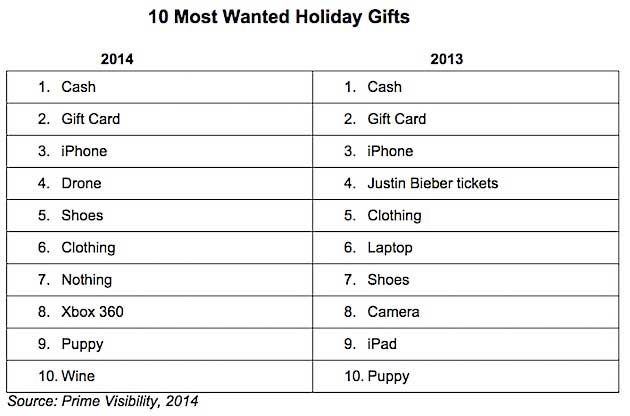
What do people want most for the holidays this year? Good ol' cash, according to a recent report from Prime Visibility.
The report was based on data from millions of conversations about holiday gifts occurring on Facebook, Twitter, and forum communities.
The top three most wanted gifts of 2014—cash, gift cards, and iPhones—are the exact same as those of 2013, the analysis found.
However, the number four spot is significantly different, changing from Justin Bieber tickets last year to drones this year.
Rounding out the list of the top 10 most wanted gifts are shoes, clothing, nothing, the Xbox 360, puppies, and wine.

Guardians of the Galaxy is the most wanted movie this holiday season, followed by Frozen and The Fault in Our Stars.
American Horror Story is the most desired TV show, followed by The Big Bang Theory and The Walking Dead.
In electronics, iPhones rule—taking both the first and second spots—followed by drones and laptops.
About the research: The report was based on data from millions of conversations about holiday gifts that occured on Facebook, Twitter, and forum communities.


Read more: http://www.marketingprofs.com/charts/2014/26612/the-most-wanted-holiday-gifts-according-to-social-media#ixzz3LXAa89jE

Monday, December 8, 2014

Holiday Results To-Date Strengthen The Omnichannel Message

Holiday Results To-Date Strengthen The Omnichannel Message


Sales results from the 2014 Thanksgiving weekend further support retailers’ need to focus on a consistent brand message across all channels year-round, rather than comparing in-store sales on Black Friday to online sales on Cyber Monday.
 
“This year is likely to be the first time in nearly a decade that Black Friday won't be the biggest shopping day of the holiday season in terms of traffic and sales,” reported Robert Passikoff, Founder and President of Brand Keys, Inc., in the firm’s 20th Annual National Holiday Shopping Survey.
 
“This is due in part to the fact that retailers offer deals year-round and consumers have taken that to heart, and more stores are open on Thanksgiving Day,” Passikoff explained. “With the expansion of Black Friday into an entire season (aka November) more people are shopping on — or prior to — Thanksgiving.”

Looking at results from Thanksgiving weekend, many retailers may be discouraged. Total spending fell approximately 11% year-over-year to $50.9 billion, according to the National Retail Federation (NRF).
 
But e-Commerce sales increased 32% to $766 million on Thanksgiving Day and 26% to $1.2 billion on Black Friday, comScore reported. 
 
While online purchases are increasing more rapidly than brick-and-mortar sales, the store continues to be a vital component of the overall brand experience for shoppers. In fact, there were 233.3 total shopping trips over the Thanksgiving holiday weekend, according to the NRF.
 
One trend that crosses both online and in-store is gift card purchases. Gift card sales — both plastic and digital — are expected to top all previous records during the 2014 holiday season. According to NRF’s Gift Card Spending Survey, the average person buying gift cards will spend $173, up from $163 in 2013. Total spending is expected to reach close to $32 billion, which is an 83% increase since NRF began tracking consumers’ intentions to buy gift cards as holiday gifts in 2003.
 
Gift recipients are on board with the trend. In an October NRF survey, 62% of consumers said they would like to receive a gift card, making gift cards the most requested gift item for the past eight years.

Holiday Results Q&A With Scot Wingo, CEO, ChannelAdvisor

channeladvisor-hs video anchor

Amazon, Large Format Retailers Win Out In Holiday Predictions

If you’re placing bets on which retailers will rack up the most sales during the 2014 holiday season, bet on the obvious. Amazon shoppers are planning to spend 9.9% more this year compared to last year, according to Prosper Insights & Analytics, in its report, titled: Holiday 2014: Retailers To Watch.
 
Other retailers expected to fare well this year include:
  • Nordstrom, up 7.5%;
  • Walmart, up 5.3%;
  • Costco, up 5.2%;
  • Kohl’s, up 3.0%;
  • Best Buy, up 1.3%.

Pricing And Promotions Heat Up Competition As The Thermometer Drops

To remain competitive in the current, consumer-driven marketplace, retailers can’t wait around to launch their best prices and deals during the holidays.
 
As explained by Passikoff of Brand Keys: “As we predicted, with the intense competition for consumer dollars, department stores and specialty shops had to become more aggressive on deals, promotions, and operating hours this holiday season, and those realities are showing up in the real marketplace and on retailers’ bottom lines.”
 
Hopefully retailers will learn from their price and promotion inconsistencies last year, industry experts noted. “There was no consistent strategy or head-on competition among the retailers,” reported Amos Peleg Co-Founder and CEO of Upstream Commerce. “The average discount rate attained at both Amazon and Zappos (at different times in the scale), was 2.8%, but was only 0.5% for Macy's.”
 
Also during the 2013 season, Upstream Commerce examined pricing of the 20 largest athletic shoe brands at Amazon, Zappos and Macy's, finding that “each lowered its prices to start the holiday shopping season; and while Amazon discounted the most on Black Friday, it then raised prices the most for Cyber Monday.”
 
Peleg offered three key takeaways when it comes to holiday pricing strategies:
  1. “Each retailer appears to dance to its own drummer with no consistently obvious strategy in relation to each other.”
  2. “Although different products are considered, Amazon exhibits the same type of behavior each year, where it raises prices on Cyber Monday.”
  3. “While there may be a smaller set of ‘show’ products that are actually being discounted, it's probably a myth that retailers provide huge discounts across the board during the holiday season.”
To help retailers determine where they stand in an endless sea of discounts and promotions, they can look to a WalletHub survey of 5,525 deals from the 2014 Black Friday ad scans of 21 of the largest U.S. retailers:
  • JCPenney has the highest overall discount rate at 65%. Costco has the lowest at 21%.
  • Jewelry is the most discounted category at 58%. Electronics & Computers are the least discounted at 30%.
  • The average discount for Black Friday is 39%. 
  • The Toys category has the most discounted items, representing 26% of all offers. The Consumer Packaged Goods category has the smallest, with only 1.3% of all offers.
Following is a breakdown of additional spending trends and takeaways from Thanksgiving — also called Gray Thursday — to Cyber Monday.

Thanksgiving Day Shopping Becomes A Holiday Hit, Boosts Store Sales 24%

Thanksgiving Day has evolved into a shopping holiday over the past three years. Not only did top retailers such as Walmart and Target open their doors earlier on Thanksgiving Day, but they also started their holiday doorbusters earlier than ever.

Although industry experts argued whether opening on Thanksgiving would help or hurt retailers, results are pointing to the former. Total in-store sales for the day were up 23.7%, with holiday shoppers spending a total of $3.19 billion, according to ShopperTrak.

The early openings were a success, bringing in12% more store traffic on Thanksgiving than 2013, according to data from Shopkick. In fact, 30% of all Black Friday store visits happened before midnight Pacific Time on Thanksgiving Day, representing an increase above 18% in 2013, 16% in 2012 and 13% in 2011. The data illustrated that in-store shopper traffic peaked on Thanksgiving Day at 6 p.m. PT, which is two hours earlier than the 8 p.m. peak time in 2013.

Despite the boost in store traffic and sales, e-Commerce and mobile shopping dominated Thanksgiving Day, with the IBM Digital Analytics Benchmark reporting that combined online sales increased 14.3% over 2013.

Online sales from desktop and laptop computers increased 32%, reaching $1.01 billion throughout the day, according to data from comScore. Online average order values (AOVs) on Thanksgiving Day were $179.59 per order, which was the highest total over the entire holiday weekend, according to Monetate.

Mobile traffic and sales experienced the highest year-over-year increase, according to the IBM Digital Analytics Bench report. Mobile traffic outpaced traffic from computer devices for the first time in 2014, with smartphones and tablets accounting for 52.1% of all online traffic. Mobile sales, on the other hand, accounted for almost one third (32.3%)of all online sales, representing a 25.4% year-over-year increase.

Mobile web sites accounted for 93% of retail revenue throughout the day, with only 7% coming from retailers’ apps, according to data from Skava.

After consumers finished their turkey dinners, they also turned to social networks to search for their favorite brands and keep track of discounts and offers. The IBM Digital Analytics Benchmark concluded that Facebook referrals drove an average of $107.73 per order, while Pinterest referrals averaged $95.24 per order.

Black Friday Underperforms Due To Thanksgiving Openings

While Black Friday has evolved to become a flagship spending day, Thanksgiving Day appeared to shake up spending patterns and consumers’ overall enthusiasm for the shopping holiday. Overall, 86.9 million shoppers either shopped in-store or online on Black Friday, a 5.5% decrease from 2013, according to data from NRF.

Total Black Friday spending in physical stores dropped 6.8% year over year to $9.10 billion, ShopperTrak data noted, while in-store traffic fell 6.6%, according to the U.S. Retail Benchmarks Report from Euclid Analytics.

E-Commerce fared more positive for retailers, with Black Friday online sales increasing 20.6% from 2013, according to a blog from Custora. Research from comScore indicated online sales from desktop and laptop computers alone jumped to $1.5 billion.

Online retailers in the Health & Beauty and Home Goods categories experienced the highest sales growth during Black Friday. Sales for Health & Beauty merchants increased 56.9% over 2013, while Home Goods stores experienced a boost of 43.2%.

Similar to Thanksgiving Day, more consumers were browsing and buying on their mobile devices on Black Friday. Approximately half (49.6%) of all online traffic on Black Friday came from mobile devices, a 25% year-over-year increase from 2013. Mobile also accounted for 27.9% of total online sales, up 28.2% from the 2013 results, according to the IBM Benchmark.

While social media as a whole drove only 1.7% of sales, email marketing had a major impact in driving online sales on Black Friday.More than one quarter (27.3%) of sales were attributed to retail emails, according to IBM. These email messages helped target customers and were sent less frequently than in the past. Retailers sent an average of 5.3 emails to shoppers this year, 11% less than Black Friday 2013.

Cyber Saturday Picks Up Steam

Although many retailers choose to take their time to reload in the days between Black Friday and Cyber Monday, in 2014 some decided to jump in to a cyber-themed weeks on Nov. 29 — leading to numbers well over last year's for Cyber Saturday. Amazon, for example, rolled out is Cyber Monday deals early.

This proved to be a hit with customers, and sales were up 45.9% over 2013, according to ChannelAdvisor. eBay, meanwhile, was up 14.9% over last year, and Google shopping jumped 19.7%. ChannelAdvisor reports that total e-Commerce growth year over year was 27%.

Data released by Monetate, a retail personalization technology provider, paints a similar picture. According to the company, shoppers initiated 30,518,366 sessions on e-Commerce sites on Nov. 29, which represents a 10.33% spike over Cyber Saturday 2013.

Mobile played a key role in the traffic increase, with both smartphone traffic — up 51.9% — and revenue — up 49.1% — well over last year's numbers. In total, tablets and smartphones accounted for 43.98% of all online traffic and 28.6% of sales. Other findings released by Monetate include:
  • The average order value of all purchases was $150.77;
  • Revenue per e-commerce session increased 14.8% year over year; and
  • Conversion rates increased 10.3% year over year.
"The Black Friday hangover impacted retailers in a very positive way as there were significant spikes in traffic, revenue and conversions on the Saturday after Thanksgiving," said Lucinda Duncalfe, CEO, Monetate. "Mobile continues to drive this trend, as it appears that shoppers browsing on Black Friday decided to make purchases via smartphones and tablets on Saturday as many deals and specials continued online."

Despite the gains, data analyzed by the Salesforce Marketing Cloud indicated that shoppers might have been ready to take a break. Social media conversations concerning holiday shopping dipped to 606,325 on Cyber Saturday. Apple led the way in social chatter on Cyber Saturday with 10,000 posts, representing a 456% year-over-year increase. Walmart while still coming in second with 8,700 post, was 21% down over last year’s social conversations. The number one topic of those discussions was Cyber Monday, which suggested positive trends for e-Commerce sites leading into Dec. 1.

Has Cyber Monday Lost Its Luster?

Cyber Monday has acquired a history of having the best online sales and deals. But this year, as retailers started their discounting tactics earlier and earlier, was that still the case? Moreover, were consumers just as eager to shop on Cyber Monday, or was their time and attention elsewhere?

Based on the projected individual holiday spend of $855, Brand Keys estimated that Cyber Monday would only account for 35% of total spending. The Cyber Monday Expectations Survey from

Prosper Insights & Analytics, also indicated that 126.9 million consumers planned to shop on Cyber Monday, a slight decrease from 131.6 million in 2013.

“For today’s shopper, every day is ‘Cyber Monday,’ and consumers want and expect great deals, especially online, throughout the entire holiday season – and they know retailers will deliver,” said Matthew Shay, President and CEO of NRF. “Retailers will still offer unique deals exclusive to Cyber Monday, but consumers also know shopping on Cyber Monday won’t be their last chance to find low prices and exclusive promotions.”

Supporting Shay’s point, research from ShopSavvy indicated that some of the deals released on Cyber Monday are just hype, and truly are not as substantial as they suggest. Data from the top 100 retailers concluded that the Electronics category had the steepest discounts, with NewEgg offering 71% off on Cyber Monday. Men’s Warehouse came in second, offering a 58% discount on Cyber Monday. Across all retailers across categories, Nordstrom offered the most discounts, slashing prices on 20,057 products.

However, results have shown something different entirely. Desktop online spending on Cyber Monday reached $2.04 billion, representing the heaviest online spending day in history, according to comScore. This is the first time in e-Commerce history that online sales surpassed $2 billion in a single day.

“With more than $2 billion in online buying on Cyber Monday to cap an exceptionally strong five-day period since Thanksgiving, the online holiday shopping season is clearly going very well at the moment and is currently running ahead of forecast,” said Gian Fulgoni, Chairman Emeritus at comScore. “Any notion that Cyber Monday is declining in importance is really unfounded, as it continues to post new historical highs and reflects the ongoing strength of online this holiday season.

Varying reports have also indicated weakness in the consumer economy due to flagging brick-and-mortar sales over the holiday weekend, but what we may really be seeing is an accelerating shift to online buying as mobile phones spur increased showrooming activity. The data we’re seeing suggest it may be more a change in shopping behavior than a lack of consumer demand.”

Results from the IBM Digital Analytics Benchmark also pointed to Cyber Monday as the most popular day for consumers to shop, with online sales growing by 8.5% year over year. Mobile traffic also grew, accounting for 41.2% of online traffic, up 30.1% over 2013. Mobile sales also surged, reaching 22% of total Cyber Monday online sales. Although online traffic and sales surged on Cyber Monday, average order value experienced a slight downturn, falling 3.5% year over year to $124.21.

Retailers Get On Consumers’ “Nice Lists” Across All Channels

Sales trends and results confirm that consumers are leveraging a variety of channels to browse and buy. As a result, a multitude of retailers ramped up their omnichannel marketing and engagement tactics to make holiday shopping more seamless and enjoyable. Here are a few standout examples:
  • Target is partnered with Google on the Art, Copy & Code project, which is designed to surprise and delight customers during the holiday season. Bullseye’s Playground is a mobile game experience that features the Target bull terrier mascot and other characters. In Target stores, guests can use Google’s Project Tango Development Tablet to interact with the Playground, which is presented as a 3D winter playground. The game also is available on personal mobile devices through Target.com/play. For every game played with Bullseye’s Playground, Target will donate $1 to St. Jude’s Children’s Research Hospital.
  • Rue La La saw a surge in mobile sales and traffic through Thanksgiving weekend. With more than 13 million members, mobile accounts for 50% of total sales. The retailer saw mobile traffic peak at 8 p.m. ET. To celebrate the start of the holiday, Rue La La implemented a variety of campaigns, including the 12 Gift Steals program, which was a five-day series highlighting must-have gifts at exclusive pricing.
  • Macy’s held a variety of doorbusters and contests to pique consumer interest and drive conversions. Black Friday deals started at 6 p.m. on Thanksgiving Day, and consumers had the chance to win digital gift codes to be used for Black Friday purchases. Using the Macy’s mobile app, shoppers scanned in-store QR codes to instantly win gift codes worth $10, $20, $50 or $250. Sharing details on overall performance for the weekend, CEO Terry Lundgren said in a Fortune article: “So far, people are gravitating to doorbusters — that has got their attention. There’s so much information online, so they’re doing that research and going right for those doorbusters.” 
The retailers that landed on consumers’ “naughty lists” were the once who didn’t ensure quality e-Commerce performance during one of the busiest weeks of the year. Best Buy, BaubleBar and HP all experienced site outages, while Cabela’s and Foot Locker experienced some instability throughout the weekend.

What's In Store For The Rest Of December?

The five day crunch between Thanksgiving and Cyber Monday has now passed, but with a recent Credit Karma survey stating that three out of four shoppers avoid Black Friday and Cyber Monday, there’s still a long way to go before consumers wrap up 2014’s holiday shopping season.

The burning question now is how will the rest of the holiday season measure up? Cyber Monday got December up to a rousing start, and early projections for the rest of the month should encourage retailers.

In total, analysts at Mintel predict a 3% increase in spending throughout December. While this number does not beat last year’s 4% year-over-year increase, it represents a total spend worldwide of more than $57 billion, with nearly 13% coming from e-Commerce. 

Heavy shopping days remain in December, according to ShopperTrak – including the Super Saturday (Dec. 20), which the location-based analytics vendor predicts to be the heaviest in-store shopping day of the holiday season. Other dates to watch include Free Shipping Day 2014 (Dec. 18) and the second Saturday before Christmas (Dec. 13). In fact, ShopperTrak predict six of the top ten shopping days of the 2014 holiday season are still to come.

“While the holiday season is underway, it’s not too late for savvy retailers to still capture their piece of the holiday pie,” said Jeff Rohrs, Vice President, Marketing Insights, Salesforce Marketing Cloud. “Each moment in the customer journey matters just as much as the one that precedes or follows it. By focusing on the present moment at hand and making it unmistakably memorable, retailers can stand out amongst the holiday noise and take the customer one step closer to the next major milestone.”

Friday, October 24, 2014

Amazon vs. Brick and Mortar


Builder and Fixer David Otani
 “Who is your competition?” This is a question I ask my retail customers and typically they respond with a few different company names, but rarely do they respond with Amazon.  Amazon’s ability to provide great pricing, critical product information including customer reviews, and deliver within a short period of time is the new standard for customer service. Retailers who cannot provide the same level of excellent service along with a great tactile experience which Amazon cannot do, will not succeed in retailing in the future.

Retailers, in general, are late to the technology party.  They are imbedded with legacy systems that were costly to deploy and now painful to write off.  That said, if retailers want to compete and stay relevant, they will have to improve their systems to provide the consumer with more information and keep track of their consumer’s activities across multiple channels.

The cost to garner a sale in brick and mortar is exponentially more expensive than on the web. However, a brick and mortar provides a tangible experience with immediate gratification that the web cannot. A brick and mortar shopping experience can include customer interaction, the ability to touch and feel a product and, of course, the option to leisurely browse the aisles of whatever products or displays that catch their eye.  Additionally, brick and mortar provides a branded experience that no third party re-seller can ever provide.

There will always be a place for brick and mortar in the retail world. This doesn’t mean the consumer will view brick and mortar with a different set of lenses. If anything, the consumer will expect more from brick and mortar because of the face to face customer experience. Therefore, brick and mortar should be determining the customer service standard, not Amazon.

 David Otani has been a retailer for over 25 years, opened over 300 stores and has held executive level positions as a general manager, planner, merchant, and real estate / construction director. David’s passion for retailing has allowed him to be part of many success stories, both new ventures as well as turnarounds.
Additionally, David lectures at FIT semi-annually, runs a Judo school, and is currently ranked number one in the U.S. in Judo in the masters division.

Wednesday, October 1, 2014

3 Ways to Attract Repeat Customers

Written by: Nicole Leinbach-Reyhle

There’s a misconception in retail that you need to gain new customers all the time when in reality, repeat customers are what any business should aim for. Of course, gaining new customers along the way should remain on any business owner’s to-do-list – but if you treat all customers in way that makes them want to return, merchants are more likely to gain long-term success.
Below are three strategies to help retailers and other small business owners alike in combating “one and only” sales and instead gaining repeat, loyal customers.

Employee Engagement 
Many businesses overlook the value of their employees and the impact they have on their customers. Particularly in retail, restaurant and service oriented businesses, employee and customer engagement is a key piece to the customer loyalty puzzle. The reason for this is actually very simple. People like to go to places that they enjoy, and they like to go places even more when they respect and enjoy the people who work there. This includes the employees – not just the owner or manager – whom they engage with.

Making employees a priority through customer service trainings, expectations and overall store standards can help create a destination that customers will enjoy not only for the product or services offered, but for the employees, as well. Setting standards within your own hiring and training habits can strengthen this, while delivering quarterly, bi-annual or at the very least, annual reviews can help, also.

Customer Value 
The Barking Cat storefront in Salem, MA is well known for it’s outstanding customer service and in return, repeat customers.
Christopher Barnard, President and Co-Founder of Points – a company dedicated to making loyalty programs more valuable and engaging – believes that offering rewards, miles or “points” is key in attracting repeat business.

“Today’s shoppers are looking for more than just products to buy: they’re also looking for points, miles and rewards to accompany their purchases. At Points, we recently surveyed over 1,500 loyalty program members from across North America to learn more about the ways that consumers want to earn with their favorite loyalty programs. The results revealed that the majority of shoppers have redemption goals in their programs (81%), and they are willing to work toward them. 66% percent of consumers agree that earning even small amounts of points or miles in a loyalty program is important to them,” explains Barnard.
Product Knowledge
Let’s face it – if you’re a small business owner competing with the big dogs like Walmart, Target TGT -0.97% or any other nationally recognized business, you have a few disadvantages at your side. This said, you also have countless advantages to your side… such as knowing your product or services offered better than anyone in your marketplace. By positioning your brand, store or business as a leader in product knowledge, customers will return to your business for stronger support, trusted expertise and valued insight over your competitors. Plus, this also puts you in a position to gain media attention by becoming your local market’s go-to-resource whenever it comes to needing insight on what you sell.

With this in mind, sharing your expertise is also a great way to lure consumers of other businesses to yours – particularly when combined with stellar employees and reward based incentives. In fact, the Points study mentioned earlier also revealed that 69% of consumers said they would break their own habits and buy a different brand or from a different company to earn more points or miles.  As Barnard explains, “this information can really help pave the way for retailers and merchants that are interested in developing a loyalty program to woo shoppers.”

To view the original article visit: Forbes

Monday, August 4, 2014

Back-to-School Shopping Sprees are a Thing of the Past

 Back-to-school shopping sprees are a thing of the past
           
Back-to-school shopping is no longer a frenzied one-day spending spree. Families are spending more, but they are doing so over a longer period of time as they search for the best deals.

Families are expected to spend $670 on average on back-to-school shopping, up 5% from last year, according to data out Thursday from the National Retail Federation. That includes spending on school supplies, clothes and electronics.

But analysts and parents say the slow economic recovery, plus access to near-constant online deals, means back-to-school shopping is no longer a big event.

Instead, parents like Tracy Seebold, 48, are shopping strategically — buying online and picking up additional in-store items when necessary. Seebold, who lives in Mifflinburg, Penn., with her children aged 10 and 14, has already purchased a few school items, including new shoes. She says she started now so that she could spread her purchases out over the next couple of months.

REVIEWED.COM: The children's lunchbox even adults will love

"We had done a big spree up until a couple years ago, but that's fallen to the wayside," Seebold says. "I love going back-to-school shopping, but it's just not possible this year."

Seebold, who plans to spend no more than $300 during the official back-to-school season, is limiting her purchases to necessities like notebooks and "first-day" outfits in hopes there will be better deals after school starts.

Many shoppers are likely spreading out their shopping, says Joel Naroff, president of Naroff Economics Advisors. He says the back-to-school season is no longer limited to a single day of shopping in the middle of July or August.

But just because consumers aren't crowding stores in the weeks leading up to school,that doesn't mean they're not spending more . Rather, Naroff says, consumers with approaches like Seebold's may actually end up spending more over time.

"It may not be the big push that retailers really expect, but it doesn't mean (consumers) aren't spending," Naroff says.

Combined spending for back-to-school is expected to reach almost $75 billion — up 3% from last year,

And it's not just parents seeking out discounts, notes Laura Champine, a retail analyst with Canaccord Genuity.

"Even kids are price sensitive now ... and are looking for a combination of good prices and good quality and good style," Champine says.

Brad Wilson of BradsDeals.com says the best way to save on back-to-school shopping is to avoid the school store and bricks-and-mortar stores in general because in-store merchandising efforts are designed to get consumers to buy more. Mark LoCastro, spokesman for DealNews, says if consumers can hold out on their back-to-school shopping until Labor Day sales, they can save even more.
Some of best deals Wilson recommends: ​

· Classroom supplies: Walmart and Staples are likely to have the best deals, but Walgreens can also have big discounts, especially at the end of July and early August. Wilson says shopping at these stores online can also save time and money. Staples currently has a coupon for $5 off in-store purchases of $25 or more.

· Backpacks: Kohl's is offering up to 40% off on backpacks and an additional 15% with the coupon available on BradsDeals.com

· Technology: Students can receive a $100 gift card from Apple when they buy a Mac or a $50 gift card when they buy an iPad or iPhone if they shop online. (The Apple Education Online Store is one of the only places to offer discounts to people with .edu email addresses.) Otherwise, Wilson says technology re-sellers like Amazon and Best Buy can help save up to $200 on Apple products.
LoCastro says the best time to purchase laptops is in August, which is when 62% of all 2013 laptop deals occurred.

Camie Donohue lives in Minnetonka, Minn., and has two elementary school-aged children. Like Seebold, she says she's limiting her budget and skipping the back-to-school shopping spree. Fortunately for Donohue, her children's school makes the classroom portion of the supply list easy with a prepackaged box available for purchase — a trend Wilson says is becoming popular among parents and schools, though he says families could save 30% to 40% by doing their own shopping online.

"If I went through every single item (in the box) and price compared, I could probably save a couple dollars," Donohue says. "But that's time I'd rather spend comparing the price of snow boots than pencils."

To view the original article visit: USA TODAY

Thursday, July 31, 2014

The Millennial Way of Shopping: More Careful, Durable, and Frugal Than You Think


Remember all those articles in the early aughts about how millennials were egotistical, privileged brats who copied whatever Paris Hilton did? (Side note: Hey, remember Paris Hilton?) As the Seattle Times put it in 2005, these kids had become ”the best-dressed, least-able, least-equipped generation ever.”

None of this is true— at least, not any more. Thanks in no small part to the worst economy since the Great Depression, millennials turned into functioning adults. They have a little less disposable income than they expected, which means that consumer companies are now changing to serve them. It turns out that today’s 18-to-34 set likes clothes and gadgets and cool stuff just as much as earlier cohorts; they just don’t buy quite so much.

A study by the Intelligence Group, part of the Creative Artists Agency, tracked the shopping habits of 1,300 people aged 18 to 34 (as well as a smaller group of those aged 14 to 17.) A little more than a third of the millennials in the study buy only “necessary” purchases—not exactly the prodigal children of popular imagination.
“Every young generation gets criticized by the older ones,” says Jamie Gutfreund, chief strategy officer of the Intelligence Group. “Gen X were slackers, boomers were those crazy hippies.” The millennials, she points out, “came of age during a period of unprecedented economic wealth and were the most materially gifted generation that had ever existed before.” It all amounted to a reputation for materialism in the early 2000s—until everything changed with U.S. economic turmoil. Joining the labor force during and after the recession, with its stunted job market, “was a little bit of a perfect storm,” Gutfreund says. “They’re now much more specific and intentioned with what they buy.”

As a millennial, I always enjoy an opportunity to turn to my older counterparts and say: “See, I’m not as narcissistic and entitled as you thought!” But if you’ve been paying attention to generational trends, the new study fits perfectly with other research that’s been done on millennials’ financial savviness and caution. A lot of this is the result of a recession from which many young people still haven’t recovered. The average college graduate now enters the job market owing about $30,000—just under the $34,500 average salary that someone with an undergraduate degree makes right out of college. (Which, by the way, is the lowest starting pay since 1998.)

In fact, a 2010 report from the Urban Institute found that the current generation has an average level of wealth 7 percent lower than people in their twenties and thirties enjoyed in 1983; this trend predated the recession. And considering the income stagnation that has dislodged the American middle class from being the world’s wealthiest, things might not improve for millennials for quite some time.


That doesn’t mean millennials won’t go shopping. They just do it differently than preceding generations. And in order to get their attention, companies need new approaches to marketing.
Nearly three-fourths of millennials do online research before buying a product. They also “prioritize access over ownership,” as the Intelligence Group study puts it, which basically means millennials prefer Spotify and Netflix (NFLX) to CDs and DVDs. This non-ownership tendency extends to the rise of Zipcar (CAR), Rent the Runway, and services that don’t require a major financial commitment. When researchers ask millennials what they value, Gutfreund says responses tend to focus on experiences such as travel—things, she notes, ”that can’t be taken away from them.”
When young people do buy something, they shy from flash-in-the-pan trends to favor more durable purchases. In response, the Intelligence Group notes, companies have been “de-branding” their designs. Denim companies, for example, are selling a lot of dark and plain jeans that will stay in style for years. And the browsing habits of millennials favor brands with seamless digital-to-storefront experience whereby what’s available online is also what’s available in stores.

This newly frugal generation has also inspired a rise in peer-to-peer, online resale markets. The Intelligence Group reports that more than half of millennials consider the resale value of an item before they make a big purchase. A lot of this is still done through established third-party sites such as EBay (EBAY) and Craigslist, but retailers like Patagonia have started to get in on the action, too.
There is one money-spending trend that the Intelligence Group study doesn’t fully explore. Millennials are about to enter the home-buying, family-starting age en masse, and that’s when big-ticket purchases become unavoidable. Right now, millennials make up about 25 percent of the U.S. workforce and spend about $200 billion a year. By 2020, when they will become the majority of the workforce, the study estimates, their annual spending will have doubled.

Just don’t expect them to buy houses and raise families the way their parents did. “They watched their parents work, work, work, buy the big house, and then lose their pension and have it taken away from them,” says Gutfreund. “They’re looking at that model and thinking, ‘I want to do this differently.’”

To view the original article please visit: http://www.businessweek.com/articles/2014-04-25/millennials-are-careful-frugal-shoppers-who-buy-for-the-long-term