Showing posts with label retail smart guys. Show all posts

Friday, June 12, 2015

Keeping Up With the Shifting Retail Scene

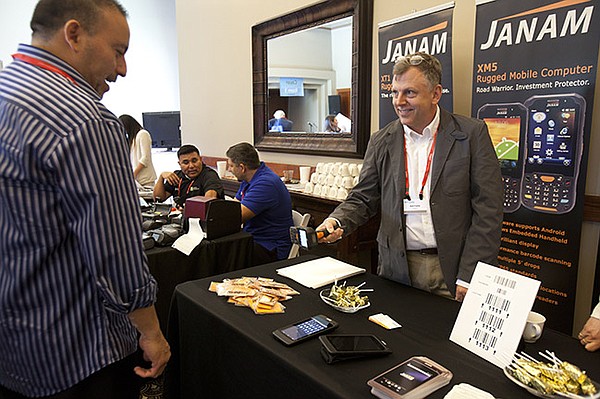
SCAN MAN: Janam showing an attendee how their scanners work and what their booth is all about.
SCAN MAN: Janam showing an attendee how their scanners work and what their booth is all about.    
By Deborah Belgum | Thursday, June 11, 2015          

Retail is an ever-changing landscape that is expanding to different horizons all the time. Many retailers are so baffled about how to be up-to-date and incorporate the maze of software out there that they don’t know where to start.

But experts have one major piece of advice: Do nothing and you die.

Whether you should be sending out emails, setting up in-store events, developing a loyalty program or posting to Facebook, something has to be done. “The first thing I want to set in your mind is if you are unable to recognize and engage your customer across every channel, your competitor will,” said Mike Mauerer, chief executive of Teamwork Retail.

Mauerer was speaking at a one-day seminar organized on June 4 by One Step Retail Solutions, a Glendale, Calif., company that improves retailers’ operating efficiencies through technology. The seminar, called “Taking It to the Next Level,” was held at the Old Ranch Country Club in Seal Beach, Calif.

Most retailers, Mauerer said, are attempting to build extensive customer email lists; posting information on various websites and channels such as Facebook, Twitter, Pinterest and Instagram; and monitoring their online shopping. “They are spending money like crazy on different things, and their staff is overworked trying to keep up with orders and synchronizing various sites,” he said.

While many retailers think that this is embracing the omnichannel way of doing business, they’re wrong. This is called multichannel.

To be truly omnichannel, the various systems have to work on one platform and talk to each other instead of acting as silos of information. That means that if a customer purchases an item with your mobile-phone app, they should be able to come into your store and return it without a hassle. The store employee should be able to call up the receipt at the cash register and see where the item was purchased and make the return easily, delivering something called “frictionless retail.”

“Most retailers are multichannel today,” Mauerer said. They need to be omnichannel, particularly when it comes to embracing shopping on smartphones and melding that system into the rest of the system. “Your customers spend more time on their phones than they ever will in your store,” he noted.


Capturing consumer information

Customers are a retailer’s most important asset. Communicating with them is paramount for conveying messages about promotions, new merchandise and special events.

“The thing that drives traffic more than anything else is email marketing,” said Dan Jablons, owner of Retail Smart Guys, a retail consulting company based in the Los Angeles area. “For every dollar you spend on emails, you get $4 back.”

But developing a good email list can be challenging. “You have to add it at the point of sale,” Jablons advised. “But don’t ask them, ‘Would you like to be on our mailing list?’ That is like saying, ‘I have some extra garbage. Would you like me to drop it on your front lawn?’ You have to make it worth something. Stop calling it an email list and start calling it a VIP list.”

“If they think there is a VIP discount or they will be invited to a special event from being on the VIP list, they will give you their dental records,” Jablons added.

That email list can be used to rustle up customers on a deadly slow Monday. “If you are freaking out about no traffic and you have to pay the rent, send out an email about a discount on sweaters and 15 people will show up,” the retail expert said.

Another successful marketing tool is holding in-store events where proceeds benefit a local charity or organization. Being tied to the community and helping out wins over customers who will patronize your store because it is a part of the neighborhood. Attracting shoppers to an event can involve discounting items, having entertainment or serving food. “As a friend says, ‘If you serve booze and chocolate, everyone will show up,’” Jablons noted.


Developing loyalty

The National Retail Federation recently conducted a study and found that the average American consumer belongs to 23 loyalty programs—from hotels and airlines to grocery stores and drugstores. “Customers want them,” said Ron Friedman, head of Friedman Business Consulting.

He noted that the first loyalty program was developed in 1896 by S&H Green Stamps, with stamps given away with purchases and pasted into books later redeemed for products.

There are various kinds of loyalty or reward programs. Friedman believes that cash back after a purchase is the wrong way to go. “Wouldn’t it be better to tell them about the $5 off before they come into the store?” he asked.

Friedman’s favorite loyalty program is the gift card that can be used by anyone and shouldn’t expire. Transferrable gift cards serve as a referral program to friends and relatives. Customers frequent you more often with a gift card in hand and spend more.

Target is an example of a retailer that gives away a gift card if a certain item is purchased. “When Target advertises this, the item is not on sale. So they get full price on the item, and you have to come back to the store to shop again,” Friedman said.


Hiring and firing

Developing a good sales staff is essential to keeping customers coming through the doors. But how do you do that?

Jablons of Retail Smart Guys suggests auditioning potential salespeople. “Try a sample shift from 1 to 3 p.m. on a Saturday. Tell them you will pay them, and then see if they can start a conversation with a customer who comes into the store and then have them pass the customer on to the sales staff,” he said. “You want to find out if they can start a conversation with a customer rather than having them walk around the store like Frankenstein.”

Jablons also recommends writing a job description and using that job description as a template for training new employees. “Once you have hired them, the biggest mistake I see is that there is not enough time spent on training,” he said.

If you have salespeople who are extremely funny, put them toward the front of the door. Also, train them to be knowledgeable about the products they are selling. “Every vendor has a story to tell, such as these sweaters were knit by monks in the Himalayas. So then your salesperson can tell the customer, ‘These sweaters were knit by monks in the Himalayas.’”

And if you find out your new salesperson can’t operate a cash register or point-of-sale system, don’t keep them. “If you don’t, your next career will be unraveling the crazy things they did at the register,” Jablons explained. “This is the spinal cord of your business.”

To view the original article please visit: https://www.apparelnews.net/news/2015/jun/11/keeping-shifting-retail-scene/

Friday, August 23, 2013

Combating Internet Pricing - A Survival Guide

Many retailers today worry about the effect of the internet on their brick-and-mortar business.  Many feel that customers will buy from the internet long before they buy from the store, mostly because of pricing and convenience.  This has been made worse by the practice of “showrooming” which happens when customers come to the store, look at a product they want, note the UPC or vendor’s style number, and then go online and find it for less than what you offer.

In fact, one of the larger online retailers who shall remain nameless became famous last year for offering a 5 percent discount to customers if they went into a local store, scanned the UPC code and bought the product online.  That was a brutally competitive move.

So how do you survive while such tactics are practiced?  What makes customers willing to buy in your store instead of buying online?  Here are some tips that we have seen work, from retail stores that are successfully beating the online merchants.


Shopping is STILL fun!  Through all the years that I have been in retail, the death of the brick-and-mortar store has been announced several times.  I remember when the catalogue business grew substantially, and there was great concern that no one would go to the stores anymore.  That has never happened, and even though it can be great to shop online, it will never compete with the social   Customers still love to go to the store, to feel the merchandise, to interact with friends and store associates, and enjoy the entire experience.  You don’t get that when you are all alone in your room.  So the first thing I would recommend is to make sure that your store is a fun place to shop.  Remember, when you open the doors, it’s “retail theater” and the party should be going on right then.  The more fun it is to visit your store, the more the customer relates to and has a great experience with your staff, the more they will visit and the more they will buy.  Keep it fun by having lots of great events, cool contests, and make your store the ‘place to be.’ 
interaction and fun of shopping at a retail store.

On top of that, make sure your sales people are offering incredible customer service.  Make sure they understand the basics of selling, of caring for and offering help to your customers.  The better the customer service, the more likely the customer will feel compelled to buy from you, right there on the spot, rather than waiting for an internet company to ship them.

Better Merchandising  Along the same lines, one of the things that helps defeat showrooming is to have great merchandising that makes the product even more desirable.  If your merchandising shows the product well, you can create instant demand for it.  And the best part about instant demand is that customers want that product now, not 2-4 weeks from now.  Entice your customers with great displays that show off the product, show how it is used, how much fun it is to have, and your customer is more likely to buy it right then and there.

The Best of The Best  Remember, one of the reasons that people go to boutiques (on top of great service) is that those boutiques have scoured the market to find the best of the best.  Sure, if you know the brand you like, you can go to their website and buy there, but what if you want to mix and match brands (to get the best of the best) and you need to know how to combine products from different brands for one solution?  For example, as you put together the nursery, you may find a changing table from Vendor A, that works really great with shelving units from Vendor B, but the bedding from Vendors C and D.  That’s hard to do on the internet.

Prepare your argument  The main advantage that brick-and-mortar retailers have over online merchants is that the product is right there, right now.  It can be a gamble to buy the product online because it could be backordered, or they could ship incorrectly.  Dealing with returns with online merchants can be a major hassle.  So when you find someone who is in your store and they appear to be showrooming, we suggest you play offense, not defense.  Tell them the above two things, but also remind them that you are a local merchant, adding dollars to their local economy, hiring local people, and the best thing they can do for themselves and their local economy is to support local business.   At the same time, you can put the product in their hands and tell them “You can have this right now, right this second, or you can go home and order it and have it a few weeks from now.  Which is better?”  We have seen this work very effectively.  As such, it would be worthwhile to spend a little time on this topic at your next staff meeting (you do have staff meetings, right?).  Talk about these strategies and get your staff ready to combat showrooming with better service, better merchandising, and better selling.

Promote Like Crazy!  One more thing that will help defeat lowball internet pricing is to make sure that you are actively promoting your store.  This means broadcasting your message on all the important channels - Facebook, Pinterest, Instagram, Twitter, etc. - and in those posts you should be showing how relevant and important your store is.  Talk about how you are watching the latest trends, how you are bringing in the most relevant merchandise, how you are ensuring that your customers always have the best of the best.  Remember, nowadays with the massive explosion of online outlets for promotion, your biggest challenge is mindshare.  You want to make sure your customers think about you when you talk about the products that you sell.  The more you can outflow (including email and all the websites mentioned above), the more likely people will think of you and your store, and come in when they need those items.

Sure, lower prices online can be difficult to overcome.  Still, the internet is not that different from any other store that offers low pricing.  Somehow though, since it’s the internet (which has the apparency of being “huge”), retailers seem to think it is harder to compete against this segment.  The truth is that if you apply the basics to your business, control your inventory well, and utilize the above strategies as best you can, you’ll keep the register ringing.

About the Author:
Dan Jablons, President of Retail Smart Guys worked in retail while attending the Ohio State University, where he graduated with a B.S. in marketing and production. He has worked with retailers such as Walmart, Target, JC Penney, American Apparel, Betsey Johnson, Donna Karan, Jimmy Choo, Charles David, Diesel, Oakley, Tumi, Hollywood Bowl, and many others. As a consultant for Retail Smart Guys, Dan brings many years of retail experience to stores of any size to improve their operations, revitalize their marketing, and maximize their profits.  For more information, email Dan at dan@retailsmartguys.com or call 818-720-2585.