Showing posts with label email marketing. Show all posts

Friday, November 20, 2015

12 Tips to Create a Killer Call to Action for Every Email

By Lisa Furgison McEwen

To create a high-performing email, you need to build it with the right components. When Ford builds its Mustang, top-of-the-line parts are used to create a driving experience like no other.

An email is the same way. Every part of an email should be the best it can be to ensure subscribers get the best experience possible.

One of the most important components in an email is the call to action, and that’s what we’ll focus on in this article. We’re going to give you twelve in-depth tips that will help every business create killer calls to action that convert subscribers.

Here are the tips to create must-click calls to action:

Call to Action Wording

What will your call to action say? You need to pick several words that entice the subscriber to click. Here are copy tips to create a variety of call to action messages that convert:

1. Keep it short
A call to action should be fairly short. There’s not a hard and fast rule on the length of a call to action, but most are about 2-5 words long. Amazon Local uses 2 words in the example below:

call to action - amazon

That’s not to say there won’t be times when your call to action is 7 words, but a call to action should be clear and brief.
 
Remember, the call to action doesn’t work alone. It’s supported by the message inside your email, so use the body of your email to convey the entire message. Your call to action should simply activate or reinforce that message.
 
Another good tactic is personalizing the call to action and using words like "Get My…," "Take Me To…," and "I Want To…" like in the email example below.
 
Merry fitness call to action

2. Capitalize on the fear of missing out

Everyone wants to be part of the in-crowd. If there’s a possibility of being left out of a good deal or a limited number of products, customers will act fast.

If you have a set number of products that you’re releasing, a deal that only comes around once a year or a product that’s likely to run out fast, make sure your call to action reflects it.
Here are a few examples of calls to action that you can use:

  • Claim your limited-time offer
  • Get it before it’s gone
  • Don’t miss out, buy now
  • Buy a limited-edition (name of product) today
  • Shop the biggest sale of the year
3. Create a sense of urgency

A call to action should create a sense of urgency, so you should choose words that encourage such. Use present tense, active words that make subscribers follow through with your desired action. Use words or phrases like “now,” “today,” “act fast” or “redeem instantly.” Any word choice that compels a subscriber to act immediately is the right choice.

shop now call to action

4. Try adding prices

If a subscriber clicks on a call to action that includes a price, it shows a high level of interest. The customer knew your price point and took the next step. That’s a customer that’s close to converting, and worth identifying.

Here are a few examples that include price points. Consider tweaking theses ideas to fit your product or service.

  • Book a cleaning service for $50
  • Shop TVs under $300
  • Upgrade your account for $5
  • Shop $20 holiday gifts
  • Find the perfect gift for $10
  • Shop popular $20 gift sets
  • See how far your $50 can go
  •  
5. Include an incentive

Your call to action text could include an incentive. Why should customers click on your call to action? Can they save 50%? Try something free for a month? Upgrade for a one-time fee? Whatever the incentive, consider adding it to your call to action.

The example below includes an incentive. It does make the call to action longer than usual, but the incentive could convert more subscribers.
incentive

Other incentives could include, “Activate your 50% off coupon now,” or “Get a free gift with your $25 purchase.”

free gift call to action

6. Go (a little) extreme

Some brands can go out on a limb and choose words that are a little extreme. Words that grab attention, are trendy or even a little risqué might be just what you need to boost click through rates.
If you market to the younger crowd, speak their language. Use trendy words like “selfie” or “totes adorbs” in a call to action.

Even if your target audience isn’t millennials, you can still create an out-of-the-ordinary call to action. For example, rather than saying, “Download the Healthy App Now” try something like “Ditch the Crappy Diet.” The second option pushes the envelope a little; it’s not stuffy corporate speak.
These choices aren’t for every brand. If language like this doesn’t fit with the overall tone of your brand, don’t force it. Above all else, stay true to your brand voice.

Button creation and placement


In most cases, a call to action button is better than hyperlinked text. It stands out and is easily recognizable to subscribers. However, there’s more to creating a call to action button than you might think. Here are a few pointers:

7. Create the best button size

How big should your call to action button be? Good question. You want a call to action button hat works on every device.

Email templates are built with a responsive design, so if you’re using an email template from an email service provider the button size will adjust to fit the user’s screen.

However, you can customize buttons with third party button creators like ButtonOptomizer. If you’re creating specifically for mobile, create a button that’s 57 pixels wide. MIT students conducted a study and found that the human finger covers 45-57 pixels on a screen.

banner-promo-basic-email-design-components

8. Pick the right button color

There’s a ton of research online that examines how customers react to certain colors. You could spend days reading which color represents dominance, or which color encourages a purchase. You’ll spin your wheels. There isn’t one magic color that will turn subscribers into paying customers or valuable leads.

To find the best color, you should A/B test them. Send a small group of contacts the same email, but with two different colored buttons and see which one gets the best results.
While there isn’t one perfect color, here are a few tips to help you find the right one:

  • Pick a color that’s used sparingly in your email text, or not at all, so it really stands out.
  • Make sure the color of the button doesn’t conflict with the text inside it. For example, if your button is red, don’t use pink text inside it.
  • Consider using a color from your logo.


Here’s a good example. National Geographic uses yellow for its "Order Now" call to action button. It’s a great choice because the color is used sparingly throughout the email and it’s part of the logo.

CTANational

9. Put the button in the right place

There’s a lot of debate about the best place for a call to action in an email. Some experts will tell you an effective call to action sits “above the fold,” or near the top of the email so subscribers don’t have to scroll down to see it. Others say the call to action should serve as an email’s conclusion.
Kissmetrics calls the entire fold argument a red herring, and says it’s all about writing good copy and presenting the information well.

It’s another component you can test to see what works best for your business.

Final tips

Before we wrap up, here are a few final thoughts to keep in mind when you create your next call to action:

10. Call to action testing

While the tips above are designed to get you on the right track, you can fine-tune a call to action by testing it. We mentioned A/B testing a few times, but it’s really the best way to optimize your performance. You can test every component we suggested. From word choice to button size, testing will tell you which call to action resonates with your customer base.

However, for testing to be effective, you should only change one thing at a time. Otherwise you won’t know what’s working.

11. Be creative

It’s okay to think outside of the box. You don’t have to use the same generic “Shop Now” call to action in every email. In fact, you shouldn’t. Subscribers like variety, so switch it up. Get creative and use your metrics to see what’s working.

12. Scan your inbox

Your inbox is home to a wealth of call to action ideas. Do a little recon and scan the emails in your inbox and pay special attention to the call to action. What grabs your attention? What do you like about it? Jot down a few notes and try those ideas in your next email campaign.
There you go, 12 tips to create a call to action button that converts.

To View Original Article: http://snip.ly/RX5s?utm_content=24433232&utm_medium=social&utm_source=twitter#http://www.pinpointe.com/blog/12-tips-to-create-a-killer-call-to-action-for-every-email

Friday, November 6, 2015

8 Awesome Black Friday Email Campaigns You Can Steal This Holiday Season


Last year email marketing drove over 27% of holiday sales according to Custora. With this year’s Black Friday set to be the biggest one yet, that number is only expected to rise.

As a marketer and business owner, it can often be difficult to come up with great emails with eye-catching images and actionable copy. That’s why I like to draw inspiration and ideas from other successful marketers and businesses.

I’m going to share eight awesome Black Friday email campaigns that you can steal and start implementing into your business. In each example, I’m going to break down what it is, why it’s so effective, and how you can implement their ideas into your holiday campaigns.

1. The Simple Sale Announcement Email


Subject: Black Friday - 40% off everything!
What it is: A simple but well-executed email from CanvasPop announcing their store-wide Black Friday sale.
Why it works: This email is all business. It clearly announces the sale and has a focused call-to-action. Sometimes, keeping things simple is the best way to go.
How to implement it: Take the simple approach to your Black Friday and Cyber Monday sale announcements. Have a clear subject line with the sale discount, and include a call-to-action in your email that brings customers to your homepage or page with the products that are on sale.

2. The Bold Imagery and Animations Email


Subject: Don’t wait ’til tomorrow! Take up to 50% off our most popular inventions right now.
What it is: Quirky uses a quirky image animation to announce their Black Friday weekend sale.
Why it works: I don’t often get animated GIFs in my email, let alone one as fun and entertaining as this. This email really stands out from other Black Friday sale announcements that will be barraging customer inboxes.
Also, all the important information is immediately clear. Free shipping, the discount, and the day the sale ends are all there in plain sight.
How to implement it: Start using animated GIFs and very unique imagery in your Black Friday emails, especially if it matches the tone of your brand.
Again, keeping your most important information above the fold is important.

3. The Free Gift Email


Subject: Black Friday + Giving Tanks
What it is: Storq created a free gift coupon instead of offering a store-wide sale.
Why it works: Storq uses Black Friday as an opportunity to increase the average order value in their store. Offering a free gift is an enticing way to get customers to your store on Black Friday.
The email design is also simple and effective. The coupon code really stands out and the instructions are clear and easy to follow.
How to implement it: You can still participate in Black Friday even if your business doesn’t typically discount or you can’t afford to lower your prices. Black Friday gives you a reason to contact your customers, so email them with any offer you can create that weekend.
If you can’t lower your prices, consider offering a free gift with a minimum purchase amount. You can easily do this within Shopify or with an app from the Shopify App Store to help.
Keep your emails simple and don’t overcomplicate your offer. When it comes to copy, less is often more.

4. The Last-Minute Extended Sale Email


Subject: EXTENDED! 50%. Off. Everything.
What it is: Julep extends their Black Friday weekend sale into Tuesday.
Why it works: Not everyone will have the opportunity to check out your Black Friday sale. Extending the sale last-second (and running a sale when competitors just ended theirs) gives customers another chance to purchase from your store.
This email is also effective because it’s unexpected. If you’ve been consistently warning customers about the impending end of your Black Friday sale and then spring a last-second extension, it’s more likely to stick out in people’s inboxes.
Lastly, the email is well designed. The three most important elements in this email contrast well against the rest: “Extended 48 hours,” “50% off everything,” and “use code cyberwow.”
How to implement it: Consider extending your sale and surprising your customers. You can even offer a new discount for the extended sale to get customers off the fence.
Don’t forget to make the most important elements in your email stand out, too. Use Julep’s email design as inspiration.

5. The Black Friday Giveaway Email


Subject: Blacked-Out Friday
What it is: Huckberry turns their Black Friday sale into a giveaway.
Why it works: Giveaways and contests can inject even more excitement into a Black Friday sale. Huckberry is giving their customers more incentive to shop on their site during Black Friday by giving each purchase a random entry into their giveaway.
Huckberry also includes more copy in their emails than most stores. Huckberry is very keen on conveying messages and telling stories in their emails, even on Black Friday.
This email in particular is too long to show in this blog post, but below their Black Friday sale announcement are stories, including the harrowing trip to Antarctica mentioned at the top of the email.
Despite being Black Friday, Huckberry hasn’t changed their established tone. Huckberry continues to deliver interesting stories, even in their most promotion-heavy emails.
How to implement it: Run a contest alongside your sale or give every customer that makes a purchase the chance to win a prize. Check out the giveaway apps in our Shopify App Store to help you put this together.
Finally, don’t diverge from your original messaging or style. If you’ve been delivering great content or stories with each email, that doesn’t need to change for Black Friday. Find a way to weave your Black Friday emails into what you’ve been doing well previously. Make it organic.

6. The Black Friday Humor Email


Subject: Sweats + Shorts = THE SCHWORTS
What it is: Chubbies stays consistent with their tone and branding and uses humor to promote their Black Friday sale on schworts.
Why it works: This email looks a lot different than the a typical Black Friday sale emails. First, the subject line is great. Next, the image of someone lounging on their couch pouring food down their mouth after Thanksgiving is really funny.
There isn’t a lot of copy in this email but it’s still effective at conveying why you need their comfortable shorts. Chubbies also shows you their shorts looking comfortable instead of only telling you that they’re comfortable.
Chubbies also chooses to focus on one product to promote their Black Friday sale instead of announcing a store-wide sale. This is far more effective since leaving customers with too much choice can be overwhelming.
How to implement it: Have fun with your marketing. If it suits your brand, experiment with unique subject lines for your emails and use humorous images.
You don’t need a lot of copy in your Black Friday emails to convey a message. Don’t just tell your customers your shorts are comfortable, show them in an entertaining way.
Lastly, you don’t need to promote several products in your Black Friday email. Promote your Black Friday sale with one product (or a few) instead. Consider choosing your best-selling or most interesting product and promote it on Black Friday to drive traffic.

7. The Scarcity Email


Subject: Woosters Almost Sold Out! Black Friday Prices + Free Shipping For A Few More Hours!
What it is: Greats gives their customers a Black Friday status report on the shoes on sale.
Why it works: Greats uses elements of scarcity throughout the email. “Moving fast,” “Almost sold out,” and “No time to be on the fence” creates a sense of urgency. Even the subject line has urgency in it with “Woosters almost sold out!”.
Of course, Greats’ personality shines through in this email as well.
How to implement it: Learn to create scarcity in your email marketing, especially on Black Friday. Create urgency and use your emails to remind your customers that your sale will be ending. Also, when your products are selling like hot cakes, tell people!

8. The Against-The-Grain Email


Subject: This Is Not A Sale
What it is: Everlane uses Black Friday as a platform to raise awareness and money for workers in China.
Why it works: The subject line is strong and piques people’s curiosity, encouraging them to open the email to learn more. You don’t often get emails on Black Friday letting you know “this is not a sale.”
It isn’t a bait and switch either; Everlane goes against the grain and promises to give 100% of their Black Friday profit to their factories in China to improve working conditions.
This gesture also helps build Everlane’s brand. It also has the chance to be picked up by news sites social media since it’s unique and generous for a time of year where businesses are focused on profit.
How to implement it: If you’re tired of running the same Black Friday sale every year, or your customers have grown to expect the same from you every year, change things up. Consider making this year’s Black Friday all about your customer or someone else in need.
It could be your opportunity to give back a little while also creating a positive brand image for your store.

Over to You

If email marketing isn’t a large part of your growth strategy, take the time to learn why it’s important for your business. If your email list is small, start building it now to make the most out of Black Friday. You don’t need a gigantic email list for your Black Friday to matter, but the bigger your list, the better. With the right amount of engaged subscribers and awesome, well-crafted emails, your business can have a great Black Friday.
Want to crush it this Black Friday? Check out the 26-point checklist I put together to position your store for success this holiday season.
If you have any questions or Black Friday email ideas you’d like to share, leave a comment below. I engage with and respond to everyone.

To View Original Article: https://www.shopify.com/blog/56776517-8-awesome-black-friday-email-campaigns-you-can-steal-this-holiday-season

Sunday, October 25, 2015

3 Sales Development Tips for Improved Messaging

By Michaela Cheevers


Throughout the creation of our guide The Sales Development Messaging Toolkit we took a hard look at the sales development function and the type of email, voicemail, and social selling strategies that are necessary to succeed in sales. With over 14 years of experience managing teams of SDRs for various clients, we have found the best strategies to write emails, voicemails, and social messages. However, finding the “easy” method of scripting these just doesn’t cut it anymore. There is a unique formula that requires a combination of skill and technology to ensure your SDRs are engaging with prospects and maximizing their efforts. The following is a redactment from our guide.
To get your SDRs started on the path to improving their messaging strategies, here are a few of our top sales development tips:

Watch Your Tone in Email Messaging

You may need to coach your reps, especially those who ar
e new to the business world, to maintain a professional tone in their emails. Our CEO and Co-Founder, Peter Gracey, went into great detail about the current trend in today’s sales development emails. If your SDRs have spoken with their prospect in the past and established a rapport with them, they can generally be more casual in their correspondence, but otherwise, it’s best to err on the polite side. Ensure that your reps are performing a routine spelling and grammar check. Also, make sure your reps avoid asking too many questions in introductory emails, as prospects will immediately recognize this sales tactic and will most likely pass over the email; instead, they should provide statements about their product or service’s effectiveness and ask when a good time is to speak with them.


Don’t Be Redundant in Voicemails


Don’t waste precious seconds on redundancy, as time is extremely valuable when leaving a voicemail. Also, avoid sentences like, “We are experts in the field of…,” or “We’re the world leaders in…” Your reps will come off as conceited, and nobody wants to hear jargon. Try to be more human. Using phrases such as “When we last spoke…” or “When we discussed this a few months ago…,” will personalize your conversation, and your prospect will be more willing to re-engage.


Take Advantage of Social Media


Unfortunately, only 5% of B2B sales teams consider social media a successful lead generation method (Ken Krogue). However, reps who use social selling are 50% more likely to meet or exceed their sales quota (Liz Gelb-O’Connor). In fact, 72.6% of salespeople using social selling as part of their sales process outperformed their sales peers and exceeded quota 23% more often (Aberdeen). The first message that your rep sends out to a potential prospect should be informative and not openly salesy. When you’re getting to know someone on social media, it’s good to incorporate social listening as well. Does the prospect publish on LinkedIn? What kinds of tweets do they post?


To view original article: http://ow.ly/TMvoo

Monday, July 13, 2015

Amazon Prime Day

Posted

Amazon Prime Day
 

Yay!! It’s Almost Amazon Prime Day!
 
What is it you ask? It is a great opportunity to develop goodwill with your customers. Don’t miss the chance to take advantage of the cultural fanfare there will be about it.
 
What is it really? On Wednesday, July 15, Amazon is declaring their own holiday to celebrate their 20th anniversary. According to the company, Prime Day will include thousands of short “Lightning Deals.” These featured bargains will change as often as every ten minutes. In addition there will be many different “Deals of the Day.” Amazon claims that they are offering more sales on July 15 than on Black Friday only to their Prime members.
 
Some say that they are copying their biggest global rival, Alibaba, who did something similar last year with huge success. It is also an effort to gain favor with their best customers before the competition starts. Both eBay and Walmart are expected to launch similar subscription services soon.
 
Remember when Amazon was still an ugly website that just sold books? They changed and you have to also.
 
What does it mean to you? Plenty! Let’s jump on the wagon and get our piece of the pie! It comes at a great time. You certainly have sale merchandise to get rid of – right?
 
Let’s do it. Plus it means that you can get free publicity for your store! Your local media will be searching for a local angle about this. Give it to them. Just follow our step by step directions!
  1. Name it – Your Store Day!
  2. Send out an email declaring your store holiday and tell what you are doing. We have put a handy dandy template below that you can use to get started!
  3. Emails and Facebook posts every 2 hours with special flash deals – 50% off at least and always include pictures.
  4. In store add a new deal every hour – but you are only advertising the ones on all the even hours. For example, 10am advertised special, 11am instore only special, 12pm advertised special, 1pm instore only special…got it.
  5. Specify that quantities are limited – so don’t worry about how many you have and just offer your wonderful sale customers another fantastic item as a substitute then.
  6. Offer free shipping – or free delivery when they call in to purchase. Be sure to mention that they can call to buy the deals.
  7. Schedule extra people for that day!
  8. Tell us at www.facebook.com/retailmavens what the name of your day is!!
  9. Send out a PR release to all the local papers because they will be looking for a local angle for this! (Remember – your press release is NOT a sale flyer – it’s giving them a local-news angle on why shopping local instead of jumping on Amazon is the way to go!)
    Send it out NOW.

    • Get in front of your computer and Google how to write a press release so that you have the format right.
    • Set your timer for 15 minutes to bang out the rough draft. We have made it easy for you and gave you tips below.
    • Walk away.
    • Come back and set your timer for 15 minutes more to smooth it out.
    • Then send it to every local paper, news station, radio station, mom’s groups, community organization, and anything else you can think of. Ask all your team and all your friends to share this with everyone they know.

Here is a sample email/post for a deal:

Subject: [Fabulous Brand They’d Recognize]’s most unbelievable [item] – you have 60 minutes to snag it at 75% off. GO! 
We’ve got THREE of these left, so swing in, hop on the site, or pick up the phone and call us at [insert your number so they don’t have to go looking for it!]. When they’re gone or the clock strikes [next hour], they’ll turn back into pumpkins and you’ll be surrounded by a group of mice with no prince, no ball, no gown, and no 75% off [item]. 
Call us for happily ever after! See you again at [time of next email]!

Here is a sample email to alert them to all of it:

Subject: Oh, no they didn’t! 
You know who they’re like, right? Amazon is just like that friend who throws himself a surprise birthday party and gives you a list of what you need to bring and where he’s registered. And, look! He’s so nice. He itemized what your portion of the catering bill will be. Sweet. 
You’ve probably heard about the Amazon Prime Day happening on the 15th. If you’re an Amazon Prime member, they’d like you to pretend it’s Black Friday and buy all their deals and crazy markdowns. If you’re not an Amazon Prime member, they hope you’ll just hang out, pressing your nose to the glass until you finally cave and join up. 
It’s okay! We know that sometimes you just need to order your toilet paper, a Kindle book, headphones, and tap shoes all at the same time and have it in 2 days. And hey, maybe one day you’ll get lucky and your tap shoes will be delivered by drone. 
BUT! 
Amazon may be cool and convenient, but it is NOT local, and it will never know who you are, remember to ask about your sister, or support your community. It just won’t. (But drones. We know! Just stick with us here.)
So this July 15th, in between getting your headphones for 35 cents and having them pay you to take delivery on those tap shoes, swing in to [STORE NAME]. We’ve declared it 
[STORE NAME] DAY 
Even though we won’t have any drones, we WILL have a new deal every hour, HUGE discounts on our most popular brands and items, and the best part? We’re just down the road, staffed by people who LIVE HERE, TOO, and you don’t even have to wait two days to take your new [items] home. 
Stay tuned to our Facebook page [LINK THAT UP] for more info, and watch for our speed-deal emails on the 15th – we’ll send out a few so you don’t miss the good stuff (but don’t worry – our emails will go back to their regular weekly format after we party like it was 1999 and Amazon was still an ugly website that just sold books.) 
See you on the 15th! 
[YOUR NAME AND YOUR STORE’S NAME] 
 
To view the original post visit: http://www.retailmavens.com/amazon-prime-day/ 

Wednesday, May 20, 2015

Memorial Day marketing tips for a successful start to summer

As part of our ongoing series which focuses on consumer and marketing trends around major holidays throughout the year, we’ve just released the Memorial Day Holiday Hot Sheet.

Memorial Day marketing emails are all about offers and sales

Experian Marketing Services looked at over 150 brands that sent Memorial Day emails in 2014 and mailings with offers or sales in their subject line made up over 80 percent of the Memorial Day mailings compared to 37 percent of promotional mailings sent by all brands in May of 2014.

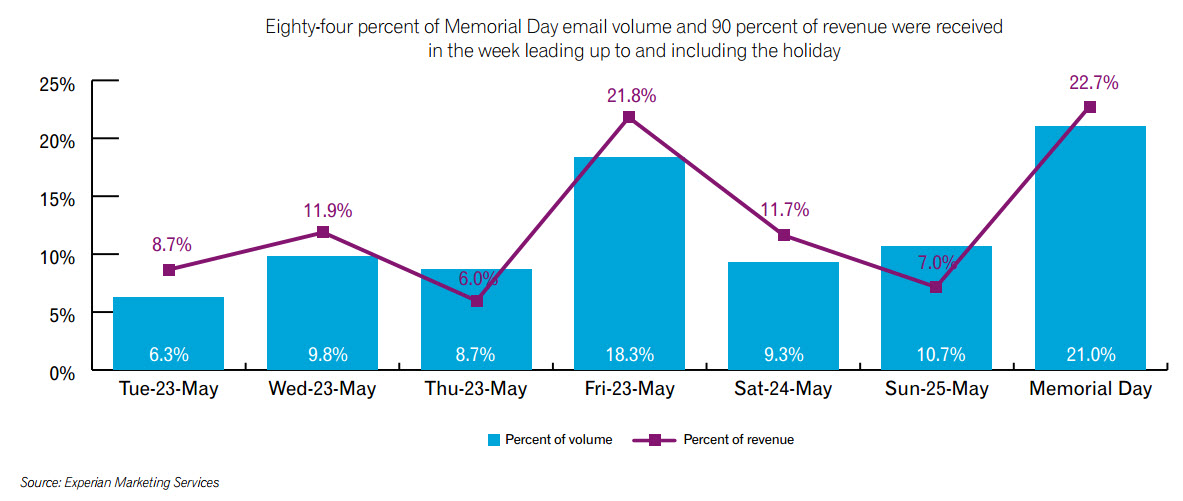
The week leading up to Memorial Day has the lion’s share of email volume and generates 90 percent of Memorial Day revenue. While the holiday itself had the highest percentage of revenue, the Friday at the start of the Memorial Day weekend may be a good day to increase mailings, as it received 21.8 percent of Memorial Day revenue from just 18.3 percent of volume.

Memorial Day email volume and revenue

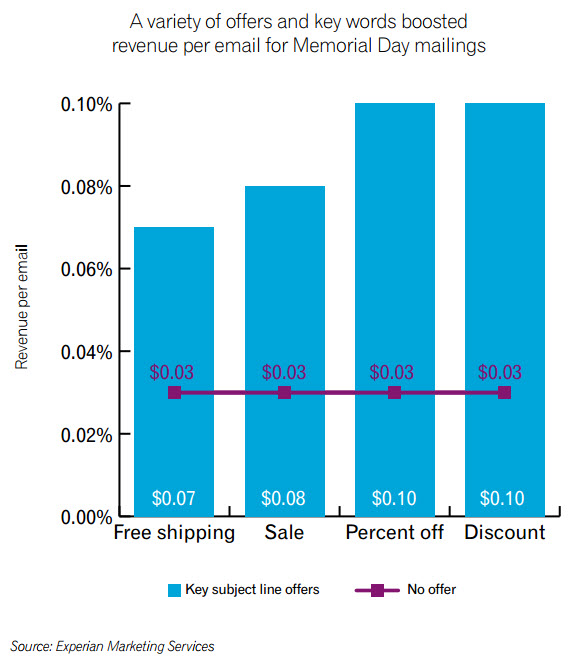
While most Memorial Day emails included offers in the subject line, free shipping and percent off subject lines yielded the greatest revenue per email. Subject lines with the key words of “sale” or “discount” also enjoyed high revenue per email.

Memorial Day offers and keywords


The search is on

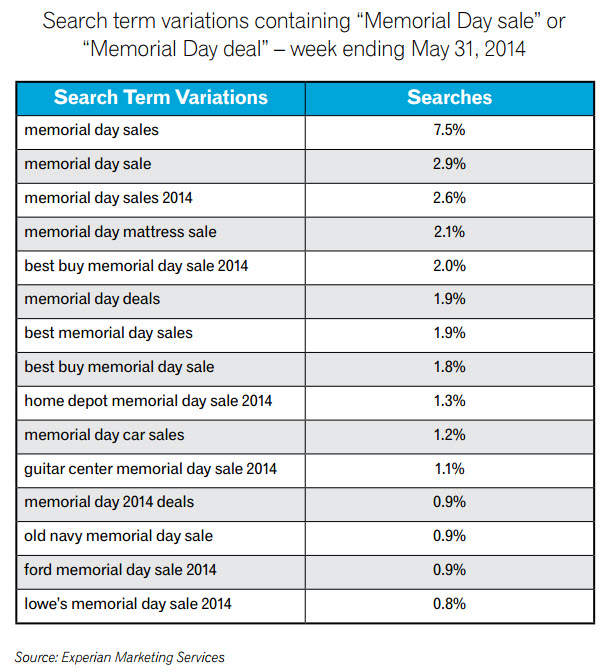
When searching for Memorial Day sales or deals online, many Americans are commonly seeking out sales at specific retailers with some of the top being Best Buy, Home Depot and Guitar Center. In fact, seven of the top 15 variations of searches for “Memorial Day sales” or “Memorial Day deals” in 2014 contained the name of a retailer. Several variations also included reference to a type of product without mentioning a specific brand. For instance, “Memorial Day mattress sale” was the fourth most common variation of searches for Memorial Day sales or deals during the week ending May 31, 2014 and the highest ranking product category-related search that week. Vehicle-related searches also occupy two spots in the top 15.

Memorial Day search term variations

With many businesses closed or operating on a holiday schedule on Memorial Day, it’s no surprise that in the days leading up to the holiday and on Memorial Day itself, shoppers are trying to figure out where and when they can shop — regardless of whether there’s a sale going on. For instance, on Memorial Day last year, the fourth most commonly used keyword in Memorial Day-related searches was “open” and the 13th most common keyword was “hours.” In many instances, consumers are looking for information on a specific retailer, such as “is Office Depot open Memorial Day” or “Kohl’s Memorial Day hours.” Though some are seeking general information such as which business are open.

Memorial Day marketing Tip


To view the original article please visit: http://www.experian.com/blogs/marketing-forward/2015/04/23/memorial-day-marketing-tips-successful-start-summer/

Wednesday, January 21, 2015

6 Mistakes that Can Get Your Emails Marked as Spam (Even if You’re Not a Spammer)

6 Mistakes that Can Get Your Emails Marked as Spam (Even if You’re Not a Spammer)
                   
You’re not a spammer.

You value customer relationships and work hard to build trust with your customer base.

But even with all the work that you’re doing, you’re still seeing a handful of spam complaints when you send out your email marketing campaigns.

What are you doing wrong?

Because spam reports are often a matter of opinion — someone receives your email, decides it is unwanted, and clicks to “report as spam” — it can be difficult to figure out what you’re doing wrong.

While there’s no foolproof system for avoiding spam reports completely, there are certain warning signs you can watch out for as you prepare to send your next email campaign.

Let’s take a look at 6 common mistakes that you’ll want to avoid:

1. Not asking for permission


People open email from people they know, and they delete or mark as spam email from people they don’t recognize. It’s really that simple.

Permission-based email marketing is the best route to developing long-lasting email marketing relationships. When you ask permission, you’re able to build a list of people who are interested in your business and are excited to hear from you. They’re more likely to open your email, less likely to mark it as spam, and will stay with you longer than contacts that are added without consent.

Asking permission also keeps you in compliance with legislation such the Controlling the Assault of Non-Solicited Pornography and Marketing Act (CAN-Spam) and the Canadian Anti-Spam Legislation (CASL).

2. Hiding your identity


Even if you ask for permission, if people can’t recognize that your emails are coming from you, they could still mark your emails as spam.

An easy fix to this problem is to use a familiar from name and from email address. If you have an email address that includes your business’s website, choose that address over one from a personal account.

Another easy fix is to add your branding to the emails you send out. Include your logo in a prominent location at the top of your email and choose colors that represent your business.

3. Sending irrelevant content


Your email content doesn’t have to be bad or offensive to be marked as spam. Often, the worst offense you can commit is to include content that simply isn’t interesting or relevant to the people you’re trying to reach.

Even if people aren’t marking your emails as spam, if they aren’t interested in what you’re sending it’s likely that they will send your emails to trash without giving you a second thought.

Pay attention to what’s working with your audience. Look at your email reports to see which content is getting the highest number of clicks. If you’re still not sure what people are interested in, ask them! You can use an online survey to collect feedback from your audience or update your sign-up form to include options for people to choose when signing up.

4. Breaking promises


When someone signs up to receive your email communications, they do so with the expectation of receiving something of value. If you don’t communicate clearly what that value is — or if they are signing up for one thing and receiving something different — you could be putting yourself at risk.

Give subscribers clear expectations before they share their email address. Let them know how often they’ll be hearing from you, what type of information they’ll receive, and why it’s a good idea to sign up.

Then, set up a welcome email to re-affirm their decision and remind them about what they’re going to receive.

5. Overwhelming your audience


Selling your products or services is an important part of email marketing, but if you’re sending too much promotional material you could be driving some people away.

This is why it’s so important to find a balance in the type of content you send out. As a standard, we recommend 80 percent helpful/informative content and 20 percent promotional.

When you are including promotional content, make sure it’s timely and relevant to the person you’re trying to reach. People are much more receptive to promotions if it helps them solve a problem they are faced with at that time.

Finally, keep an eye on your overall sending frequency. Even emails that are jam-packed with helpful content can be viewed as spam if you’re sending too frequently.

6. Making it difficult to opt-out


Often, people will mark email as spam because they simply want to get off a list.

While it can be difficult to let go, if you have people who aren’t interested in receiving your emails, it’s better to give them the option to opt out than to try to keep them on your email list.

If you’re a Constant Contact customer, there will be an unsubscribe link in every email you send out. Also, make sure to monitor the inbox for the address you are using to send your email campaigns, as many people will reply to your email and ask to be taken off your list.

If you’re focused on providing value to your email audience and are taking the right steps to obtain permission, you’re already on the right track to avoiding spam complaints.

Hopefully these tips help you solve your spam setbacks.


To view the original article please visit: http://blogs.constantcontact.com/avoid-spam-reports/?cc=SM_FB_ConstantContact

Tuesday, September 2, 2014

The Small Biz Suggestion Box


Your store may not have a physical "suggestion box," but there are many new ways to find helpful feedback that may not be so obvious. The more you know your audience, the better you can tailor your messaging to resonate with their interests and needs. Owning and/or operating an independent business is hard work, and sometimes it's easy to be too close to the project to see the bigger picture.

Customer feedback is the key to a successful business. In the age of social media, chances are if a customer has a bad experience, you can say goodbye to that customer AND their friends. That's why embracing customer feedback is the key to keeping your business alive and well. A cardboard box sitting on your retail counter can't always get the job done. Here are some suggestions on getting productive feedback:
  1. Use Email Marketing. Send regular emails to customers about sales, new products and store updates to keep them involved. You can simply send out an email campaign that says, "Tell us what you think!" for an open-ended approach. Depending on your mailing list size, you can prompt your customers to reply back with feedback or an answer to your open-ended question. Another option is to provide a small survey for customers to fill out online using a free tool such as Survey Monkey. Asking for feedback through email gives customers the time to think through their answer rather than putting them on the spot.
  2. Include Incentives. When asking customers to give feedback, try to incorporate an incentive, "Please take the time to fill out this customer survey and automatically be entered to win 50% off of your next purchase." This way people who may not have thought about giving their feedback initially, may reconsider. You can give away prizes such as gift cards or a basket filled with some of your most popular products. These incentives can help boost online engagement and drive more customers into your store. Incentives can be used for more than just feedback. If you're gathering donations for a charity or hosting a contest; be creative!
    artisan basket.PNG
  3. Ask Your Employees. More often than not, employees have great suggestions but aren't sure if it's their place to speak up. Encourage your employees to submit any ideas they might have to boost sales or improve business. Have a "brainstorming" meeting with your employees and encourage everyone to speak freely about their new ideas.
  4. Use Facebook and Twitter. Facebook and Twitter are the perfect ways to reach a massive audience in one or two simple sentences. Update your social media sites with a status or tweet reading, "We want to hear from you! Comment below (or tweet us) your favorite product that we carry. Those who comment will be entered to win our latest giveaway!" Give a deadline to create a sense of urgency and encourage more people to participate. On a Facebook Page, there is an exclusive tab for customer reviews built into the profile. Customers can give your business a rating based on a five star scale as well as write a brief testimonial. First time visitors to your Facebook Page will see your business's average rating on the left-hand side of the page.
    Pats -Monograms1
  5. Let customers stock the shelves. There is always a chance that there are great products out there that you have never even heard of. Have a "Stock Our Shelves!" event, where customers come and submit their ideas about products they believe would be a good fit for your store. Take these new products into serious consideration because it's a great way to keep customers coming back if you are the only store in the area that carries their favorite brand.
  6. Build a presence on review platforms. There are websites that serve the purpose of an online suggestion box. Add your business's information to websites such as Yelp, Google Places, Truelocal and more. Refer to our roundup below and update your listings.
 
Encourage customers to give your business a review. Include links to these sites in your monthly newsletter or in-store signage. The more reviews and traffic you receive, the more likely you are to appear in search results. This is a great way to gain new customers through the feedback and loyalty of existing ones.
 
Try out a few different ways to get customer feedback to figure out what works best for your store. Whether you host contests, develop email campaigns or build your presence on review platforms, you'll be sure to hear a lot of suggestions to implement into your marketing.  
 
To view the original article visit: The Small Biz Suggestion Box

Wednesday, July 16, 2014

Meet the Retail Expert


One Step Retail Solutions chatted with retail expert, Dan Jablons of Retail Smart Guys, to learn about the best retail solutions for your business! President of Retail Smart Guys, Dan comes with over 30 years of retail experience and has worked with a leading POS provider, and top retailers such as Diesel, Oakley, Tumi, Target and many others. Dan graduated with a Bachelor of Science in Marketing and Production from Ohio State University and has been making his mark in the retail industry ever since. We were very fortunate to steal a moment from him, so we could pick his brain about what’s in store for the future of retail.
 
What makes you a retail expert?
I have over 30 years of retail experience, including store management, buying, and operations management, as well as ample experience in software and management tools used in retail stores,  in over 14 different countries.

What do you like best about the retail industry?
The excitement of working with people on the bleeding edge of the market place. I love the creativity and excitement that independent retailers bring to the marketplace!

How can retailers increase sales?
There are two key components to help drive sales: email marketing and a series of in store events. It is important to send at least two emails a week to customers.   It is also important to and have a series of in store events that are fun and compelling and give customers a reason to go shopping.

What suggestions do you have for people looking into new Retail Technology?
 Retail technology is vital because connecting a POS system with strong planning systems allows inventory forecasting, protects cash flow and maximizes investment. The biggest investment is having the tools to manage what happened so you’re able to prepare yourself for what is going to happen.

What advice can you give a new retail business?
1.    Make sure you are buying for your customers and not buying for yourself.

2.    Invest in purchasing the best measurement tools so you can keep track of your sales and inventory.

3.    Recognize that retail is a science and an art. Work with people that can assist you with the science pieces as well as the art pieces.

What are some new retail trends you’ve noticed in the industry?
There is tighter integration with customer demand to get the right inventory, at the right place, at the right time.
What’s the best piece of business advice you’ve ever received?
Retail is detail. The solution of problems means digging into details, to manage the demands in any retail store.

Thanks very much for your time Dan! We appreciate the retail expert advice and look forward to working with you again soon!